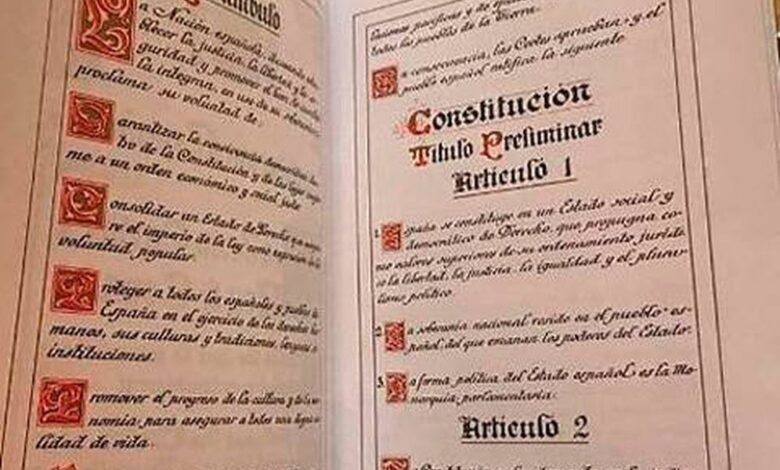
December 6th in Spain is not just another public holiday—it’s a date that unites the entire country. On this day, Spaniards remember the moment when the nation took a decisive step toward democracy. Marked in red on the calendar, this day is celebrated across all autonomous communities, regardless of local traditions and customs.
For many, it’s a chance to gather with family, take a short trip, or start preparing for Christmas. Yet behind the festive atmosphere lies a deep historical significance that continues to shape the lives of millions.
Historical context
In 1978, after decades of dictatorship, Spain stood on the threshold of change. On December 6th, a referendum was held where citizens were asked whether they supported the new fundamental law. The result was clear: nearly 88% voted ‘yes’ to the Constitution. This document became the cornerstone of modern Spanish democracy.
Work on the text of the Constitution was carried out by representatives of various political factions. Seven deputies, later known as the ‘Fathers of the Constitution,’ managed to reach a compromise between differing interests and viewpoints. Among them were politicians from UCD, PSOE, Popular Alliance, and the Communist Party. Their names—Gabriel Cisneros, Miguel Herrero y Rodríguez de Miñón, José Pedro Pérez-Llorca, Gregorio Peces-Barba, Jordi Solé Tura, Manuel Fraga, and Miquel Roca—are forever etched in Spain’s history.
Festive events
On this day, official ceremonies, festive events, and educational initiatives take place across Spain. In Madrid, the doors of the Congreso de los Diputados are traditionally opened so that anyone can learn about the workings of the country’s main legislative body. National flags are raised in public squares, and schools and universities hold lessons dedicated to the history of the Constitution.
Although for many people this holiday is not as emotionally significant as, for example, Christmas, it remains an important part of national identity. Constitution Day serves as a reminder of the value of democracy, and the freedoms and rights established in 1978. This is especially relevant today, as segments of society continue to view the country’s past in different ways.
Significance for Society
The Spanish Constitution not only defined the structure of government but also enshrined the fundamental rights and freedoms of citizens. It became a guarantor of political stability and the peaceful coexistence of different regions and cultures. Thanks to this document, Spain was able to overcome internal divisions and reach a new stage of development.
In recent years, interest in the history of the Constitution has grown noticeably. Young people are increasingly participating in related events, and educational programs have become more comprehensive. This is due to the fact that, according to surveys, a significant part of the population still does not fully realize the importance of the democratic reforms that took place in the late 1970s.
Current Challenges
Although the Constitution has served as the foundation of the country for nearly half a century, debates about its content and the need for reform continue. Some political groups advocate for updating certain provisions to adapt the core law to new realities. However, most citizens still view the Constitution as a symbol of unity and stability.
On this day, Spaniards not only take a break from work but also reflect on the country’s future. The holiday becomes an opportunity to discuss pressing issues such as human rights, the structure of the state, and Spain’s role in the modern world.
If you didn’t know, the Spanish Constitution (Constitución Española) was adopted in a referendum on December 6, 1978, and came into force on December 29 of the same year. This document lays out the foundations of the state, guarantees citizens’ rights and freedoms, and establishes the principles for all branches of government. Constitution Day is an official national holiday celebrated across the country every year. On this day, various events are held to strengthen civic identity and promote legal awareness.