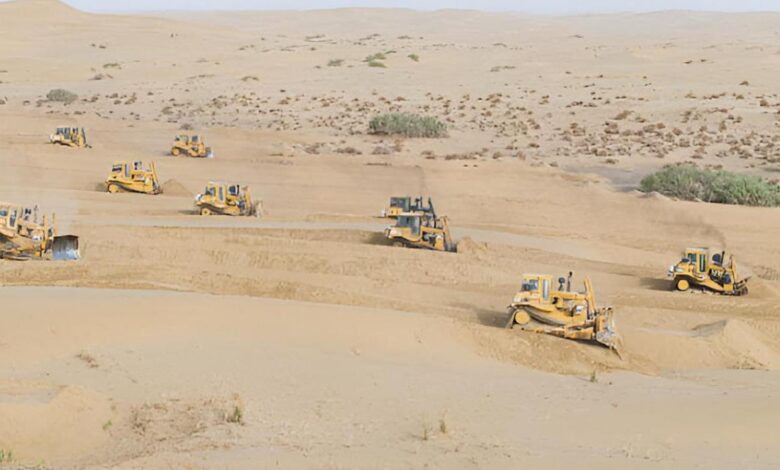
Contrary to popular belief, the vast sandy deserts of Saudi Arabia and the United Arab Emirates do not spare these countries from having to import sand from thousands of kilometers away. The rapidly growing mega-cities need special construction materials, and local dunes are useless. This seemingly absurd paradox is due to the structure of the grains: wind has polished them over centuries into perfect spheres, which means they can’t hold cement together. Durable concrete requires angular, rough particles that are only found in riverbeds, lake basins, or on the seafloor.
As a result, despite having millions of tons of sand underfoot, Gulf countries have to buy it from suppliers in Australia, China, and even Belgium. Their sand is ideal for building skyscrapers, bridges, and artificial islands. In recent years, Australia has become a global leader in sand exports, and demand for this resource is only increasing. Ambitious projects like NEOM, Qiddiya, and large-scale developments in Dubai and Abu Dhabi require materials that meet the strictest international standards.
Sand as a strategic resource
Sand ceased to be just a building material long ago. Today, it is a strategic resource fiercely contested around the globe. Worldwide sand consumption has already exceeded 50 billion tons a year, with only a fraction of that volume suitable for construction. The rest is either too fine, too smooth, or simply does not meet technical requirements.
In the Persian Gulf countries, where urbanization is rapidly accelerating, demand for high-quality sand keeps rising. Local authorities spare no expense on imports, as the success of their ambitious plans to transform desert landscapes into futuristic cities depends on it. However, behind this construction boom lies a worrying trend: sand extraction across the world is becoming increasingly aggressive and uncontrolled.
Environmental concerns
Large-scale sand mining leads to ecosystem destruction, the loss of coastal zones, and a decline in biodiversity. In some regions, irreversible consequences are already evident: entire beaches are disappearing, river courses are shifting, and fishermen and local communities are suffering. Sand, which may seem inexhaustible, is actually a finite resource—and its depletion could trigger severe environmental disasters.
In response to these challenges, scientists and engineers are seeking alternatives: developing technologies for recycling construction waste, creating artificial sand, and proposing stricter controls on extraction. Yet, demand for natural sand remains high, and countries with ambitious construction programs continue to buy it worldwide.
Global market and emerging risks
A new international market is taking shape, where sand becomes the subject of strategic deals and even political disputes. Australia, China, and Belgium are strengthening their positions as key suppliers, while the Gulf countries are becoming increasingly dependent on imports. This reliance brings new risks: supply disruptions, rising prices, the emergence of illegal mining, and even conflicts between nations.
As Middle Eastern megacities continue to expand and construction cranes never stop, the question of sand’s future is becoming more critical. Whether alternative technologies will provide a solution, or humanity will face a new shortage, will become clear in the coming decade.