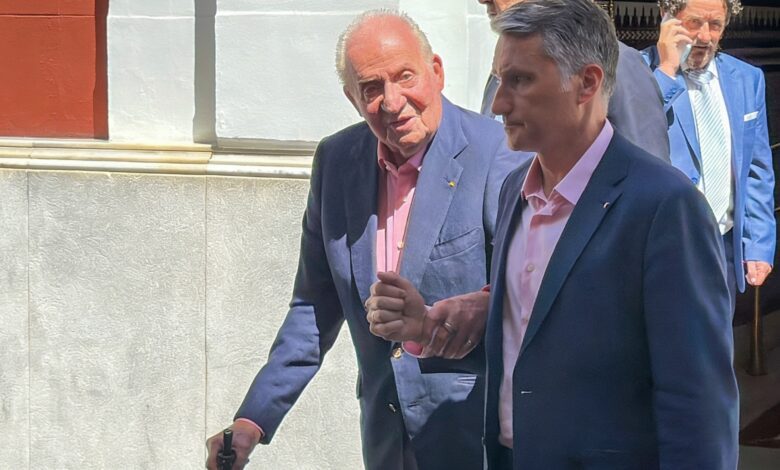
The arrival of Juan Carlos I in Seville became a significant event nationwide. His appearance at the opening of the bullfighting season at the Real Maestranza not only drew public attention, but also reignited the debate about his possible return to live permanently in Spain. For many Spaniards, this event is closely linked to discussions about the future of the monarchy and the role of the former king in the country’s modern history.
As El Pais notes, Juan Carlos I arrived in Seville on a private jet from Abu Dhabi, where he has lived since 2019. His visit coincided with the return to the arena of the renowned matador Morante de la Puebla, who will face bulls again after a six-month break. The program also features Roca Rey and David de Miranda, with bulls provided by Garcigrande. The event’s appeal was heightened by the presence of Infanta Elena, the former monarch’s eldest daughter, at the official pre-corida evening, where journalist Rubén Amón was a guest speaker.
Return conditions
The question of Juan Carlos I’s return to Spain has been under discussion for several months. Recently, Partido Popular leader Alberto Núñez Feijóo publicly called on the former king to come back to his homeland. However, Juan Carlos I himself insists on one fundamental condition: he will only agree to return if he can live in his former home—the La Zarzuela Palace, where he spent more than half a century after marrying Queen Sofía. This stipulation remains the main obstacle to his return, since the palace serves not only as the residence of the royal family but also as the official headquarters of the head of state.
To prevent further scandals involving the former monarch, the authorities and Casa Real agreed that Juan Carlos I would not stay overnight at La Zarzuela or other state residences during his visits to Spain. This decision followed a series of investigations and public pressure to minimize potential harm to the reputation of the monarchy.
Legal aspects
In March 2022, the Spanish prosecutor’s office closed investigations into Juan Carlos I’s overseas assets, after Swiss authorities had made a similar decision earlier. Following this, the former king officially notified his son, King Felipe VI, of his intention to continue residing in Abu Dhabi, though he did not rule out regular visits to Spain. In his letter, he emphasized that should he return, he would arrange his personal affairs and accommodation outside of state-owned properties.
Since then, every visit by Juan Carlos I to Spain has sparked discussion regarding his status and the conditions of his stay. His most recent trip was last November, when he attended a family lunch at El Pardo marking the 50th anniversary of the monarchy’s restoration. A planned visit in March to a regatta in Sanxenxo was canceled due to flight restrictions stemming from the conflict in the Middle East.
Public reaction
Debates continue in Spain over the future of the former monarch and his role in the country’s life. For some, the return of Juan Carlos I represents an attempt to restore confidence in the monarchy, while for others it is a reminder of past scandals and the need for reform. Every visit sparks new discussions about transparency, responsibility, and the traditions of the royal family.
According to El Pais, Juan Carlos I himself does not hide his desire to return but is unwilling to compromise on his living arrangements. As long as this issue remains unresolved, his stays in Spain will be temporary and attract heightened attention from both the media and the public.
In recent years, Spain has repeatedly become the stage for high-profile events linked to the monarchy. For example, in 2023, the royal family’s visit to the national day celebrations sparked debate, while in 2024 changes to official event protocols drew public interest. Each of these cases triggers a broad public reaction and shapes perceptions of the monarchy. Such events highlight just how important the issues of succession and transparency are to Spaniards when it comes to the country’s highest authorities.