Global Debt: New Records and Shifting Power
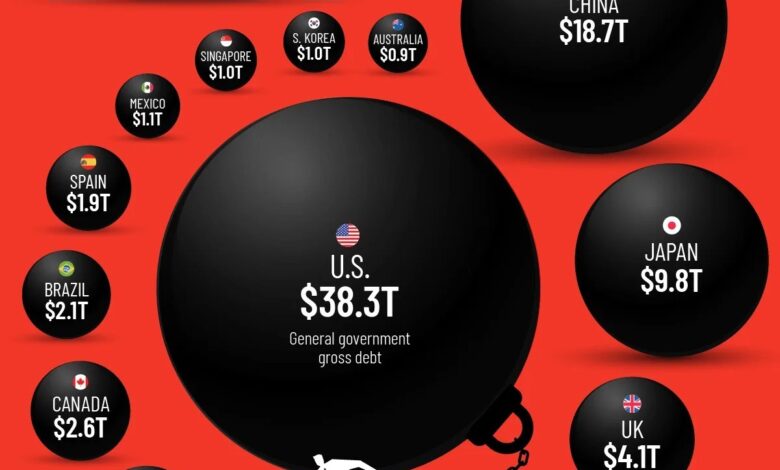
In 2025, the total government debt of all countries worldwide surpassed $110 trillion for the first time. The largest share of this amount is held by several major economies, which continue to expand their obligations. Experts estimate that the top five nations account for about 67% of all global debt, while the top ten hold as much as 81%.
USA and China: Key Players in the Debt Market
The United States remains the absolute leader in terms of government debt, reaching $38.3 trillion in 2025. China is second, with a total of $18.7 trillion. Together, these two countries make up just over half of all sovereign obligations worldwide. Japan, the United Kingdom, and France also rank among the top five debtors, with a combined debt of $17.8 trillion.
Trends: Rising Government Debt Levels
Over the past year, the United States increased its debt by $2.9 trillion, while China added $2.2 trillion. Although the total figures differ, China’s debt grew faster: 13.6% compared to 8.4% in the US. Japan, the United Kingdom, France, and Italy also showed significant growth in government debt, driven by ongoing budget programs and demographic changes.
European Economies and Spain: Position in the Rankings
The top ten countries with the highest government debt also include Italy, India, Germany, Canada, and Brazil. Spain ranks eleventh with a debt of $1.9 trillion. It is followed by Mexico, Singapore, South Korea, and Australia. Most of these countries face a heavy debt burden both in absolute terms and relative to their gross domestic product.
Reasons for growth: fiscal measures and an aging population
The key drivers of rising public debt remain large-scale fiscal programs implemented to support the economy, as well as demographic trends related to population aging. These factors strain developed countries’ budgets, forcing governments to borrow additional funds.
Looking ahead: potential consequences
Experts point out that further increases in sovereign debt could affect the stability of the global financial system. Analysts are closely watching the actions of the largest economies, as they largely determine the dynamics of the global government bond market and the stability of currency exchange rates.