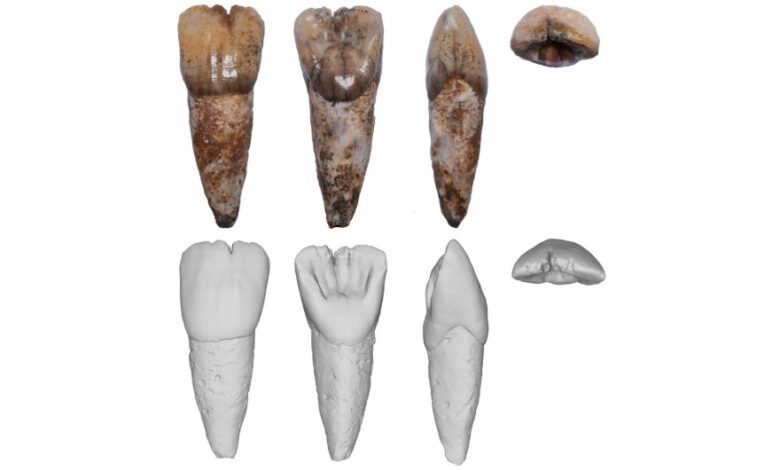
In Niah National Park on the island of Borneo, archaeologists have discovered a unique artifact — a human tooth that had lain in the ground for tens of thousands of years. The discovery was made in Traders Cave during extensive excavations carried out between 2017 and 2019. During this time, researchers carefully studied layers of ancient deposits, using modern dating methods to accurately determine the age of the finds.
The main sensation was the discovery of a complete adult central incisor found in a layer formed about 55–52 thousand years ago. Morphological analysis revealed that this tooth does not resemble the remains of Homo sapiens known to science. Its size and structural features fall outside the range typical for modern humans, immediately sparking intense discussion among paleoanthropologists.
The ancient inhabitants of Sundaland
Sundaland — a vast region that included present-day Malaysia, Indonesia, and surrounding islands — was a meeting point for various human species during the Late Pleistocene. According to recent studies, Homo sapiens reached this area no later than 65–50 thousand years ago, as evidenced by finds from Australia and Indonesia’s Lida Ajer cave.
However, other members of the Homo genus may have also inhabited Southeast Asia during that time. Genetic studies of modern populations indicate possible interbreeding between sapiens and Denisovans, as well as with the mysterious ‘hobbits’ (Homo floresiensis) from Flores Island and the dwarf humans from Luzon (Homo luzonensis). The new discovery from Kalimantan adds yet another puzzle: who did this tooth belong to—an unknown species or one of the already described archaic populations?
Technologies and methods
To determine the age of the tooth, scientists used several methods: radiocarbon dating, optically stimulated luminescence, and uranium-thorium dating. This comprehensive approach allowed them to precisely establish that the layer in which the incisor was found formed between 55,000 and 52,000 years ago.
The tooth’s morphological features were carefully compared with collections of both ancient and modern remains. Results showed that in several respects this incisor is closer to archaic humans of East Asia than to modern sapiens. The crown size is particularly notable—it is significantly larger than the average for Homo sapiens, suggesting it may belong to a distinct population or even species.
Discovery context
Traders Cave has long been known to archaeologists as a site where artifacts from various eras, starting with the Paleolithic, are found. Recent expeditions have uncovered not only human remains but also numerous artifacts that highlight the region’s complex settlement history. Each new layer reveals details of the daily lives of ancient Kalimantan inhabitants, their routines, and their interactions with the environment.
Alongside ongoing excavations in Malaysia, other parts of Southeast Asia are also seeing active research. For example, in the Laotian cave Tam Pa Ling, fragments of a skull and tibia were discovered that may belong to early Homo sapiens who lived there 70,000 to 86,000 years ago. These discoveries are gradually revealing a new picture of human migration and evolution in the region.
Scientific significance
The discovery of an archaic human tooth in Kalimantan could reshape our understanding of settlement in Southeast Asia. If the hypothesis about its connection to an unknown population is confirmed, scientists will have to reconsider migration routes and interactions among different Homo species. This could also shed light on mysterious episodes of gene mixing detected in the DNA of modern regional populations.
Specialists are still analyzing the tooth’s morphology and internal structure, and searching for additional remains to gain a fuller picture. Each new piece of information has the potential to overturn long-held views about the history of Southeast Asia’s human populations.
In case you didn’t know, Darren Curnoe is a renowned Australian paleoanthropologist and professor at Western Sydney University, specializing in the study of ancient human populations in Asia and Australia. His team has repeatedly made discoveries that have changed scientific understanding of the migrations and evolution of Homo sapiens. In recent years, Curnoe has actively collaborated with researchers from Vietnam, China, and Malaysia, enabling large-scale interdisciplinary projects in some of the most remote regions on the planet.