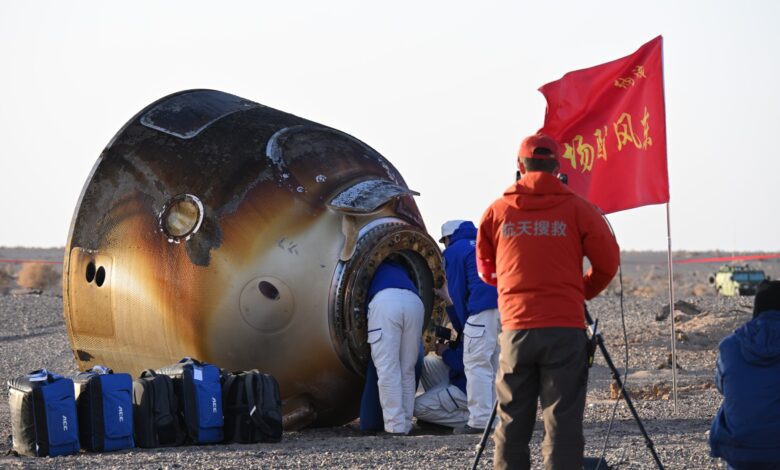
China’s space program has once again come into the spotlight after an incident involving a manned spacecraft at the Tiangong orbital station. The Shenzhou 20 craft, which was supposed to bring three astronauts back to Earth, suffered serious damage in a collision with space debris. As a result, the crew’s return was postponed, and the spacecraft was declared unfit for safe flight.
Initially, the crew was scheduled to complete their mission on November 5, but on that day, the China Manned Space Agency (CMSA) unexpectedly announced an extension of the astronauts’ stay on the station. The reason was a crack discovered on the spacecraft’s porthole, caused by the impact of a microscopic debris particle traveling at high speed. This posed a threat to the crew’s safety upon reentry to Earth.
Given the circumstances, the decision was made not to take risks and avoid using the damaged craft for reentry. Instead, the astronauts waited for a new spacecraft to arrive, which brought them home nine days after the original scheduled date.
Emergency replacement
After the main crew returned to Earth, only the new Shenzhou 21 mission crew temporarily remained on the station. However, they had no backup spacecraft that could serve as a ‘lifeboat’ in the event of an emergency. This situation created some tension among specialists and observers of China’s space program.
To eliminate the risk, China promptly launched another crewed spacecraft into orbit. The launch took place on November 22, and within a few hours the new vessel successfully docked with the station. As a result, the Shenzhou-21 crew once again has the option of emergency evacuation if necessary.
It was decided to return the damaged Shenzhou-20 to Earth without a crew on board. According to CMSA representatives, the spacecraft will be thoroughly examined after landing to gather valuable data for future missions and improve flight safety.
Causes and consequences
Agency specialists described the nature of the damage in detail. According to them, cracks in the porthole were caused by a piece of debris measuring less than one millimeter. Despite its tiny size, the impact velocity was so high that the glass could not withstand the stress. Had the spacecraft returned to Earth, exposure to temperature and pressure could have expanded the cracks, risking the destruction of the porthole and complete loss of airtightness.
As a result, it was decided not to risk the astronauts’ lives and to send the ship back home in automatic mode. The exact date of return has not yet been announced, but specialists are already preparing to conduct experiments and analyze the damage after landing.
The Shenzhou-21 crew will continue working at the station until the end of their six-month mission. Their tasks include conducting scientific research and educational projects. The next rotation, the Shenzhou-23 team, is scheduled to go into orbit in April 2026.
International experience
The incident with the Chinese spacecraft reminded experts of a similar event that occurred a year earlier aboard the International Space Station. At that time, the crew of the American Boeing Starliner was also left without their own means of returning to Earth. However, they did have a backup option: if necessary, the astronauts could have used an additional module on the SpaceX Crew Dragon.
Both incidents have again raised the issue of the need to create specialized space rescue services and to expand international cooperation in this area. Experts believe that only joint efforts can help prevent future tragedies and ensure the safety of crews in orbit.
In recent years, the problem of space debris has become increasingly pressing. Even the smallest particles can cause serious damage to intricate equipment in microgravity. The Chinese experience highlights the importance of swift response to such threats and having clear protocols in place for emergencies.
The future of missions
While the Shenzhou-21 crew continues their work, specialists are analyzing the causes of the incident and developing new safety measures. In the coming years, China plans to increase the number of manned launches and expand the capabilities of its orbital station. Work is underway to create new debris protection systems and improve emergency procedures.
The international community is closely monitoring developments on Tiangong. The Chinese program is becoming increasingly ambitious, and its successes and setbacks impact the global space industry. Issues of safety and cooperation are coming to the forefront, as they determine not only the success of individual missions but the future of space exploration as a whole.
In case you didn’t know, the China Manned Space Agency (CMSA) is the government organization responsible for all of the country’s manned missions. Since its founding in 1992, CMSA has carried out dozens of successful launches, including the construction and operation of the Tiangong space station. In recent years, the agency has been actively developing international partnerships and introducing innovative technologies to improve the safety and efficiency of its programs.