In early November 2025, the Chinese space station Tiangong experienced an emergency situation. Three astronauts—Zhang Lu, Wu Fei, and Zhang Hongzhang—were left without the possibility of emergency evacuation. Their transport spacecraft Shenzhou-21 had been used to return the previous crew after window damage was discovered, believed to have been caused by a collision with space debris.
For ten days, the crew remained in uncertainty: in the event of an accident on the station, they had no backup vehicle to return to Earth. This situation raised concerns among experts and sparked discussions on the need for international protocols to ensure safety in orbit.
Unmanned spacecraft launch: how the problem was addressed
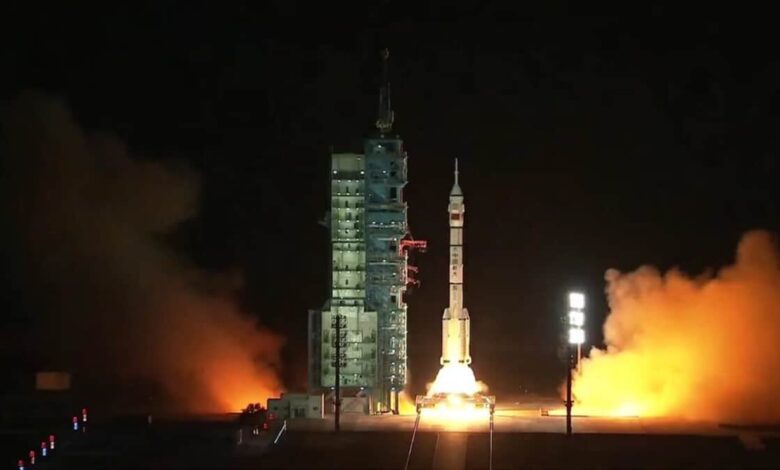
To address the threat, China swiftly organized the launch of a new unmanned spacecraft, Shenzhou-22. The Long March 2F rocket lifted off from the Jiuquan launch site, delivering the vehicle to the station. If the docking succeeds, the astronauts will once again have the ability to safely leave orbit in case of an emergency.
The crew is expected to continue their six-month mission on the station until April 2026, when they will be replaced by the Shenzhou-23 team. The damaged Shenzhou-20 currently remains in orbit for technical experiments, but the timeline for its deorbiting has not yet been determined.
Parallels with international space missions
The incident on Tiangong recalled similar past events in global space exploration. In 2024, the American Starliner spacecraft by Boeing faced technical difficulties after arriving at the International Space Station. NASA decided to return the vehicle to Earth without a crew, forcing astronauts Sunita Williams and Butch Wilmore to spend over nine months in orbit awaiting their return aboard SpaceX’s Dragon ship.
These incidents have once again raised the issue of establishing an international space rescue service capable of promptly responding to emergencies and ensuring crew safety, regardless of the mission’s country of origin.
The Future of Orbital Safety
Experts note that as the number of crewed missions and objects in low Earth orbit increases, safety concerns are becoming ever more pressing. Damage caused by space debris can have severe consequences if crews lack reliable backup evacuation options.
China’s experience demonstrates that rapid response and the availability of backup spacecraft are crucial to preventing tragedies in space. International cooperation and knowledge sharing between nations may provide the foundation for an effective emergency response system in orbit.
In case you didn’t know: What is Tiangong and how is China’s space program developing?
The Chinese orbital station Tiangong (translated from Chinese as ‘Heavenly Palace’) is a national project by China to create its own long-term platform in low Earth orbit. The station’s first module entered orbit in 2021, and by 2025 the facility became fully inhabited and capable of supporting extended missions.
China’s space program is advancing rapidly: the country regularly launches crewed and cargo missions, conducts scientific experiments, and tests new technologies. Unlike the International Space Station, Tiangong is operated entirely by China, allowing the country to pursue its own scientific and technological objectives.
Shenzhou-class spacecraft are used to deliver crews and payloads to the station. Each launch is carefully prepared and controlled, and the program itself has become a symbol of China’s technological progress. China is heavily investing in developing rocket technologies, life support systems, and communications, enabling the country to compete confidently with leading space powers.
In the coming years, China plans to expand the station’s capabilities, invite international partners to collaborate, and launch new scientific projects. Tiangong has already served as a platform for unique experiments in microgravity and for testing advanced materials and medical technologies.
Thus, the launch of the unmanned spacecraft to the station is not only an urgent measure to ensure the crew’s safety, but also another step forward in developing the national space program, which continues to gain momentum and attract worldwide attention.