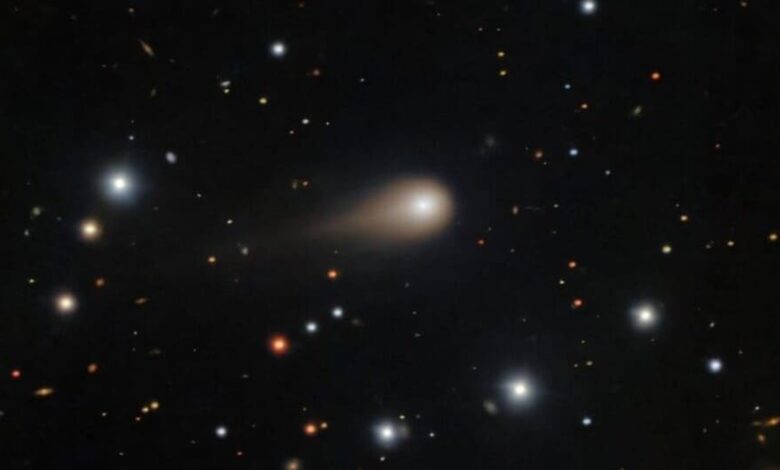
The interstellar comet 3I/ATLAS has once again captured the attention of the scientific community after Harvard professor Avi Loeb put forth an unusual hypothesis about its possible mission. According to him, the object’s trajectory and recorded anomalies in its acceleration could indicate that the comet was not just a cosmic wanderer, but a sort of ‘courier’ delivering technological devices to the vicinity of Jupiter.
The researcher noted that 3I/ATLAS changed its speed and direction near the orbit of the gas giant. According to his calculations, this behavior cannot be explained solely by the gravitational influences of the Sun and the planets. He believes that the recorded non-gravitational acceleration could be the result of a deliberate maneuver, allowing the comet to precisely enter Jupiter’s Hill radius—the region where the planet’s gravitational influence becomes dominant.
Analyzing the comet’s movement anomalies
The unusual properties of interstellar objects passing through the Solar System have long been a topic of discussion in scientific circles. 3I/ATLAS became the third such body detected by astronomers in recent years. Of particular interest were the data on its acceleration, which do not fit standard models for comet behavior. According to Loeb, such precise calibration of speed and direction could suggest artificial intervention or a complex internal structure.
The scientist emphasizes that without this maneuver, the comet would have passed by Jupiter without entering its gravitational field. According to him, such a scenario is unlikely for ordinary celestial bodies, which led him to consider the possibility of a technological mission behind the object.
Possible traces of extraterrestrial technology
Loeb does not rule out that unusual artifacts or devices may be discovered near Jupiter in the future, whose origin cannot be explained by natural processes. If such findings are recorded, it would serve as indirect evidence supporting his theory that interstellar comets could be used as transport vehicles for delivering probes or other technological objects by extraterrestrial civilizations.
He also notes that the interest in Jupiter may be due to its unique physical characteristics and powerful magnetic field, which make the planet attractive for research not only by Earth-based scientists, but also by hypothetical alien researchers.
Debates within the scientific community
Loeb’s hypothesis has sparked lively debates among astronomers and experts in cosmic phenomena. Many colleagues are skeptical about the idea that the comet’s maneuvers have a technological origin, pointing instead to possible alternative explanations related to the structure of the nucleus or to gas and dust emissions. However, Loeb himself insists that only continued observation and data analysis will shed light on the true nature of these anomalies.
In recent years, interest in interstellar objects has grown significantly, especially after the discovery of ʻOumuamua and Borisov (2I/Borisov). Each new appearance of such bodies in the Solar System sparks new theories and the search for traces of extraterrestrial technologies.
Prospects for future research
Astronomers plan to continue monitoring the environments of Jupiter and other gas giants in search of unusual objects. Modern telescopes and automated stations make it possible to detect even the slightest changes in the trajectories of comets and asteroids, increasing the odds of discovering new anomalies and, possibly, providing evidence of extraterrestrial technology.
If unusual artifacts are found in the Jupiter system, the scientific community will have a unique opportunity to rethink the origin and purpose of interstellar objects. This could mark the beginning of a new era in space exploration and the search for traces of alien civilizations.
In case you didn’t know, Avi Loeb is one of the most renowned contemporary astrophysicists, a Harvard University professor and former head of its astronomy department. He gained fame for his bold hypotheses about the nature of interstellar objects and possible contact with extraterrestrial civilizations. Loeb is actively involved in international scientific projects aimed at searching for life beyond Earth and regularly publishes articles in leading scientific journals. His work often sparks intense debate in the academic community, and he’s unafraid to propose ideas that challenge established views. In addition to his scientific work, Loeb is a passionate science communicator, giving lectures worldwide and supporting educational initiatives for young people. His approach to exploring space is marked by openness to new theories and a drive to expand the frontiers of human knowledge. Thanks to his outspokenness and unconventional thinking, Loeb has become one of the most prominent figures in modern astronomy.