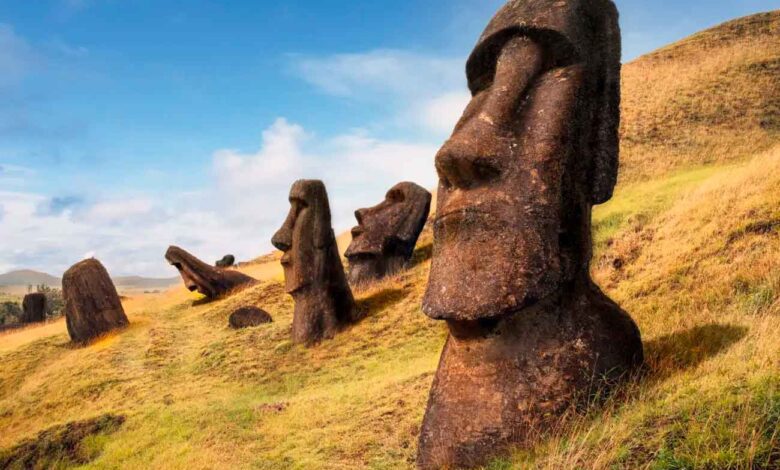
Easter Island (Rapa Nui) has long captivated scientists and travelers alike with its enigmatic stone statues. These giant figures, known as moai, have become a symbol of the island and the subject of countless theories. Debate continues over who organized their large-scale production and how it was accomplished, especially considering these are hundreds of monolithic statues, each weighing several tons. A new study by American archaeologists sheds light on this mystery and challenges long-held ideas about life among Rapa Nui’s ancient inhabitants.
For years, it was believed that moai construction was directed by a centralized authority, with all work carried out under the orders of a single ruler. However, fresh data obtained through modern technology suggests a completely different story. It turns out the statues were created by independent communities that not only cooperated, but also competed with one another, each striving to display its own strength and uniqueness.
Technology unveils ancient secrets
A team of researchers led by Carl Lipo from Binghamton University (USA) used drones and photogrammetry to conduct an in-depth study of the island’s main quarry—Rano Raraku. Thanks to these methods, scientists created an accurate 3D model of the area, revealing every trace left by ancient craftsmen. Their analysis uncovered 30 distinct work zones, each marked by unique stone-working techniques and carving styles.
In each zone, archaeologists discovered unique features found only in that area. This suggests that the entire statue-making process—from initial sketches to final touches—was carried out by the same group. Such an approach is more reminiscent of independent workshops rather than a centralized system where semi-finished statues are handed off from one unit to another.
In total, more than 400 statues at various stages of completion have been identified in the quarry, along with numerous trenches, niches, and specialized stone pillars used for transporting finished figures. All this confirms that each community had its own section and traditions, with competition between them fueling the creation of ever more impressive moai.
The myth of a single ruler is debunked
Previously, a popular hypothesis suggested that the construction of the moai was ordered by a powerful chief who united the island under his authority. It was believed that, in order to erect the statues, the inhabitants deforested the land and exhausted local resources, ultimately leading to ecological disaster and societal collapse. However, new archaeological evidence does not support this version.
Research has shown that sources of fresh water and other vital resources on the island were never controlled by a single authority. Various clans divided them among themselves, and labor was organized in a decentralized manner. Moreover, transporting the giant statues did not require thousands of people—a small group was enough, able to “rock” the moai using ropes to move them across the island.
Thus, the creation of the stone idols was less a result of orders from above and more an expression of rivalry among independent communities. Each clan sought to stand out by erecting its own unique statue—this competition was the main driving force behind the mass construction.
New perspectives on the history of Rapa Nui
Rethinking the role of rivalry in the lives of Easter Island’s ancient inhabitants also changes our understanding of why their society declined. Previously, the disappearance of forests and depletion of resources was blamed on a single ruler, but now it is clear: no one individual or group could control everything. Decisions were made at the level of individual communities, each acting in its own interest.
This discovery not only explains the variety of moai styles and sizes, but also highlights the complexity of Rapa Nui’s social structure. Instead of a single central authority, there was a network of autonomous clans competing and interacting with each other. This perspective offers a fresh look at the island’s history and its mysterious monuments.
Ultimately, the giant stone statues that became symbols of Easter Island were not the result of orders from a single ruler, but the outcome of years of rivalry and a drive for self-expression among different communities. This finding changes not only our understanding of Rapa Nui’s past, but also the very way we view the creation of great ancient monuments.
By the way: who is Carl Lipo
Carl Lipo is a renowned American archaeologist and anthropologist, and a professor at Binghamton University. He specializes in the study of ancient Oceanic societies and applies modern analytical methods to archaeological sites. Lipo is one of the leading researchers on Easter Island and has published dozens of scientific works on the history and culture of Rapa Nui. His approach is notable for integrating technologies such as drones and 3D modeling, making it possible to uncover new data about the past. Thanks to his research, many long-held views on labor organization and the social structure of the island’s ancient inhabitants have been re-examined. Lipo actively collaborates with international research teams and participates in expeditions around the globe. His work has earned recognition in the academic community and sparked broad public interest. In recent years, he has continued to explore not only Rapa Nui but also other regions of the Pacific, making a significant contribution to the development of archaeology.