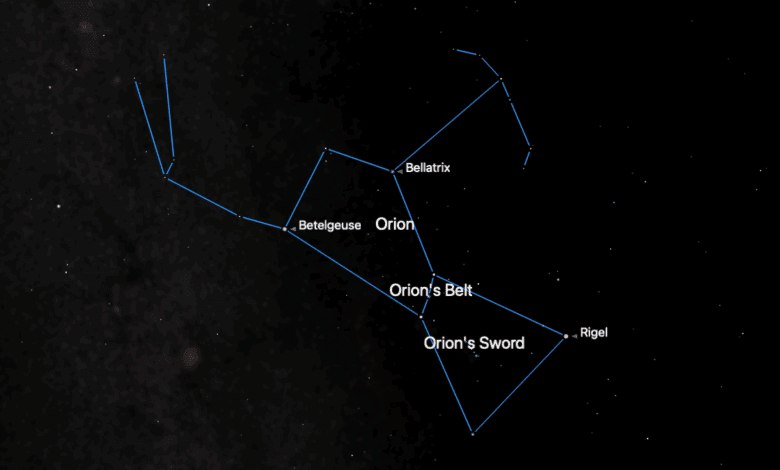
On the evening of December 18, residents of Spain will be able to witness one of the most beautiful phenomena of the winter sky. After nightfall, the constellation Orion will appear in the southeast, clearly visible even in urban areas. Pay special attention to the vertical chain of faint stars just below Orion’s famous belt. This is the so-called Orion’s Sword, which astronomers distinguish as a separate feature of the constellation.
At the center of this ‘sword’ hides a remarkable object—the Orion Nebula (Messier 42, M42). It appears as a soft, glowing cloud surrounding one of the stars in the chain. Even to the naked eye, you can spot its faint glow, and with binoculars or a small telescope, an amazing sight unfolds: a swirling cloud of gas and dust, where new stars are born.
The Orion Nebula is the nearest large star-forming region to our planet. It lies about 1,500 light-years from Earth and is part of the Milky Way. Thanks to its brightness and size, this nebula is considered one of the most accessible objects for observation—even for beginners. On a clear December night, it’s especially visible if you get away from city lights.
Where to look
To find the Orion Nebula, look for the three bright stars that form Orion’s Belt. These stars are almost perfectly aligned in a straight line and can be seen right after sunset. Below the belt, slightly off to the side, you’ll notice a vertical row of three fainter stars—this is Orion’s Sword. The middle one will appear as a slightly blurry spot—that’s where the famous nebula is located.
The best time to observe is from 7:00 PM to midnight, when the constellation rises higher above the horizon. During this period, the atmosphere is less turbulent and light pollution is minimal. For those in large cities, it’s recommended to head outside the urban area for the clearest view.
What you can see
Even without special optics, the Orion Nebula appears as a small, bright cloud. However, with binoculars, you can make out its structure: a central region packed with gas and the faint stars surrounding it. Through a telescope, even more details emerge—dark lanes, bright knots, and even individual young stars that have just formed.
Astronomers note that the Orion Nebula is a unique laboratory for studying star formation. Here you can observe how new stars form from clouds of hydrogen and dust, and track their evolution. For stargazers, this is a rare opportunity to see a birthplace of stars with your own eyes.
Observer tips
Before heading out to observe, it’s a good idea to check the weather forecast—cloud cover can completely obscure the nebula from view. The best conditions are nights with minimal clouds and low humidity. Don’t forget to bring warm clothes—December nights can be quite chilly.
For photographers, the Orion Nebula is a fantastic subject for astrophotography. Even a regular DSLR camera and tripod can capture impressive shots with a long exposure. The most important thing is to remember safety and choose secure locations for stargazing.
If you didn’t know, the Orion Nebula (M42) is one of the most extensively studied objects in astronomy. Its discovery is credited to French astronomer Nicolas-Claude Fabri de Peiresc, who first described it in 1610. Today, the nebula serves as an important laboratory for scientists worldwide and remains a favorite target for millions of astronomy enthusiasts. RUSSPAIN.COM regularly publishes articles on the most fascinating night sky events so you never miss a single cosmic occurrence.