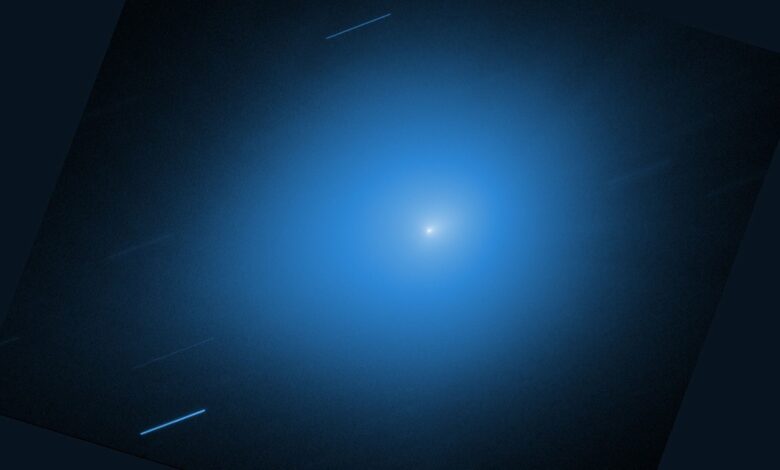
At the end of November 2025, the Hubble Space Telescope once again turned its lenses toward an unusual object—interstellar comet 3I/ATLAS. Using the Wide Field Camera 3, NASA specialists captured new images of this rare visitor as it approaches the Sun and Earth. 3I/ATLAS is only the third major interstellar object ever discovered, and each such encounter offers astronomers new opportunities for research.
Scientists believe the comet formed in a distant protoplanetary system around another star. It was likely ejected from its home system by a powerful gravitational maneuver triggered by a massive exoplanet. Since then, 3I/ATLAS has been wandering through the Milky Way, traveling billions of kilometers, and is now approaching a star this closely for the first time.
A cosmic wanderer
The closest approach to Earth is expected on December 19, 2025. On that day, the comet will be close enough to be observed even with small telescopes or powerful binoculars. For astronomers, this is a unique chance to study the composition and structure of an object that does not belong to our Solar System.
Interstellar objects have been recorded extremely rarely in the past. In 2017, 1I/’Oumuamua was discovered, and in 2019—comet 2I/Borisov. Each had a different composition and behavior. For instance, 2I/Borisov contained more carbon monoxide than water ice, which is unusual for comets known in our system.
Chemical composition
The first data from the James Webb Space Telescope revealed that 3I/ATLAS is rich in carbon dioxide. This indicates that it formed much farther from its star than most comets in the Solar System. Such a composition allows scientists to draw conclusions about the processes of planet and comet formation in other star systems.
Comparing the chemical characteristics of interstellar objects with those of familiar comets helps us understand how unique our own system is and what conditions are like in other parts of the Galaxy. Each new interstellar visitor is an opportunity to expand our knowledge of the origins and evolution of planetary systems.
A window into the past
The arrival of 3I/ATLAS near Earth coincides with the Christmas holidays in 2025. This event has already sparked interest not only among professional astronomers, but also among amateur stargazers who are preparing to observe it. The comet is expected to become a prominent object in the night sky, provided weather conditions are favorable.
Astronomers note that objects like 3I/ATLAS carry information about the early stages of star and planet formation. Studying them offers a glimpse into processes that occurred billions of years ago, and allows us to compare them with what happened in our own Solar System.
In case you didn’t know, the Hubble Space Telescope is a NASA orbital observatory that has been operating since 1990. Over the decades, it has made thousands of discoveries, including observations of distant galaxies, exoplanets, and interstellar objects. Thanks to Hubble, astronomers around the world have access to unique data that can’t be collected from the Earth’s surface. The telescope remains one of the most important tools for studying the universe and its mysteries.