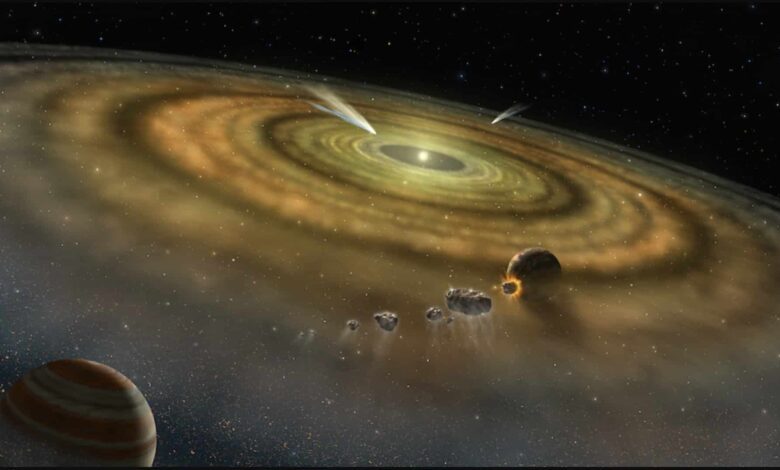
Research on iron meteorites has given scientists new insights into the processes that occurred during the first millions of years of the Solar System’s existence. Through the analysis of hundreds of samples collected over the past two decades, experts have traced how planetesimals and their metallic cores formed, and uncovered the role Jupiter played in this process. These discoveries not only refined the chronology of events, but also helped explain why our planetary system developed its distinctive structure.
At the center of attention are calcium-aluminum-rich inclusions (CAIs)—the oldest solid objects formed about 4.567 billion years ago. They have preserved unique chemical and isotopic signatures that reflect the conditions present at the dawn of the Solar System. Just a few hundred thousand years after their formation began the creation of chondrules—the ‘building blocks’ of future planets, which make up the bulk of primitive meteorites.
A research team led by Maria Schönbächler from the University of Zurich carried out a large-scale meta-analysis, combining results from over a hundred scientific studies. This approach made it possible to construct a detailed picture of the early stages in the evolution of the protoplanetary disk and to clarify exactly when planetesimals—the precursors to modern planets—began to form.
Early processes: accretion, melting, and the role of aluminum-26
According to the data obtained, accretion processes—where dust particles stick together and form larger bodies—began less than a million years after the first solid inclusions appeared. The main source of internal heat for young planetesimals was the short-lived radioactive isotope aluminum-26. Its even distribution throughout the protoplanetary disk ensured that bodies in different regions, from the future Earth to the outer edges of the asteroid belt, were heated and melted at the same time.
During the first three million years after the Solar System was formed, materials actively separated: iron and silicates parted ways, forming metallic cores and mantles. This process concluded before the radioactive heat from aluminum-26 was exhausted, as confirmed by isotopic analysis of iron meteorites—the remnants of destroyed ancient planetesimals.
Two worlds: the isolation of the inner and outer regions
Scientists found that there were two isotopic reservoirs in the early Solar System. The inner zone (NC) contained drier and hotter materials, which later formed Earth and Mars. The outer region (CC) was rich in volatile elements, water, and organic compounds—the precursors to comets and gas giants.
These two regions remained isolated from each other for several million years. Jupiter was the main factor ensuring this separation. Its gravitational pull created a kind of barrier that prevented material from mixing between the inner and outer parts of the protoplanetary disk. In this way, the gas giant defined the boundaries within which different types of planets formed.
Jupiter: Architect of Planetary Destinies
Analysis of iron meteorites and modeling of processes in the protoplanetary disk have shown that Jupiter was the key ‘architect’ of the Solar System’s structure. Its emergence and rapid accumulation of mass not only divided the inner rocky worlds from the outer belt of icy bodies, but also influenced the composition and evolution of the planets to come.
The agreement of findings from different scientific teams confirms that without Jupiter, the formation of the planetary system might have followed a completely different scenario. The gas giant not only limited the influx of material from the outer regions but also accelerated the formation of planetary embryos’ cores, shaping their future destinies.
Future Research: New Samples and Pinpointing Earth’s Origins
Scientists note that further study of the isotopic composition of rare meteorites, as well as samples delivered from asteroids by space missions, will allow for a more precise determination of where exactly Earth and its neighbors originated within the protoplanetary disk. This data will help reconstruct details of our planetary system’s early history and shed light on how unique its formation was compared to other star systems.
In the coming years, new samples are expected to arrive, which may shed light on previously unknown stages of the Solar System’s evolution. Each meteorite discovered is like a ‘message’ from the depths of space, giving scientists an opportunity to unravel, step by step, the mysteries of the origins of planets and their moons.
If you didn’t know, Maria Schonbächler is a professor at the University of Zurich specializing in cosmochemistry and meteorite studies. Her team is well known for large international projects analyzing the isotopic composition of extraterrestrial materials. Their research continues to provide increasingly precise data about the early stages of planetary system formation and the role of giant planets, such as Jupiter, in the evolution of the cosmos.