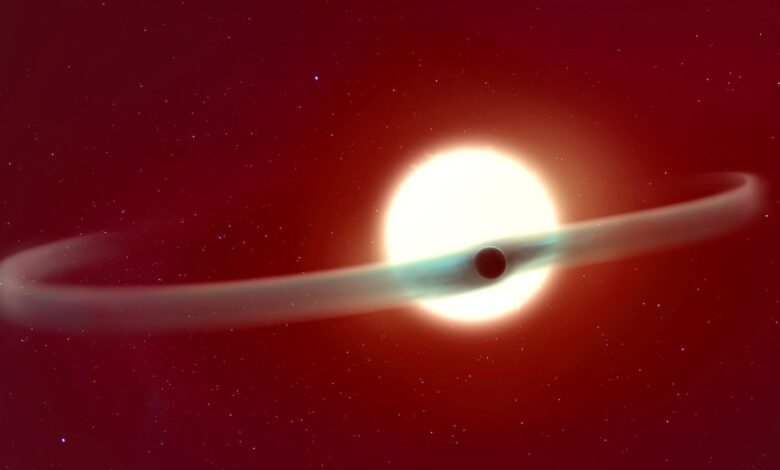
At a distance of about 880 light-years from Earth, astronomers have observed something remarkable: the exoplanet WASP-121b, also known as Tylos, is literally losing its atmosphere into space, creating two massive tails of helium. This marks the first time in history that scientists have been able to track such a large-scale and prolonged process of atmospheric escape from a planet outside our Solar System.
Previously, scientists had encountered cases where exoplanet atmospheres escape into space, but such events were usually observed only briefly—when the planet was passing in front of its star. This time, researchers were able to monitor the process continuously, capturing the planet’s entire orbit around its star. This allowed them to gather unique data about the mechanisms and consequences of atmospheric loss.
Extreme conditions
WASP-121b is what’s known as an ultra-hot Jupiter: a gas giant similar in mass and size to Jupiter, but orbiting much closer to its star and therefore heating up to extreme temperatures. A year on Tylos lasts just 30 hours, and the atmosphere’s temperature reaches several thousand degrees. In such conditions, light gases—primarily hydrogen and helium—can easily escape the planet, streaming off into open space.
The star’s intense radiation is literally burning away the atmosphere of WASP-121b, creating conditions for unusual phenomena. Among them are clouds of vaporized metals, gemstone rains, and record-breaking fast atmospheric currents. However, the double helium tails have truly stunned the scientific community.
Two tails instead of one
Using the James Webb Space Telescope (JWST), a team of researchers observed WASP-121b for nearly 37 hours. During this time, they discovered that the planet’s helium envelope extends over 60% of its orbit, and the gas forms not one but two powerful tails. One trails behind the planet, while the other unexpectedly stretches forward along its orbit.
This structure was a complete surprise to astronomers. Current computer models can explain the formation of a single tail, but a dual system requires new modeling approaches. According to scientists, several factors influence tail formation: stellar radiation, stellar wind, and gravity, all of which differently affect the gas flows.
A look at planetary evolution
Extensive and detailed observations of WASP-121b have offered new insights into the evolutionary processes of exoplanets. The gradual escape of its atmosphere could, over time, radically alter the structure of this gas giant, eventually transforming it into a smaller planet or even a bare rocky core. According to researchers, such processes may explain the diversity of observed exoplanets and their unusual characteristics.
The data obtained have already prompted scientists to rethink their approaches to modeling atmospheric loss. It is now clear that gas escape is not simply a linear flow, but a complex three-dimensional system closely intertwined with orbital conditions and interactions with the parent star.
New research horizons
The discovery of double tails on WASP-121b opens new avenues for studying exoplanets. Astronomers can now better assess how rapidly and under what conditions gas giants lose their atmospheres, as well as how these processes affect their eventual fate. In the future, such observations will help determine whether massive planets can transform into Neptune-like objects or even into completely atmosphere-less rocky bodies.
The study also raises questions about how unique these phenomena are, and whether similar processes can be detected on other exoplanets. This will require further development of observational technologies and the creation of more advanced models capable of accounting for the complex interactions between a planet and its star.
In case you didn’t know, the James Webb Space Telescope (JWST) is the largest and most advanced astronomical instrument ever launched, deployed in 2021. It is designed to study the most distant and mysterious objects in the universe, including exoplanets, galaxies, and stars. Thanks to its high sensitivity and unique capabilities, JWST has already made a number of groundbreaking discoveries, including the observation of double tails on WASP-121b. The telescope is operated by an international consortium that includes NASA, ESA, and the Canadian Space Agency.