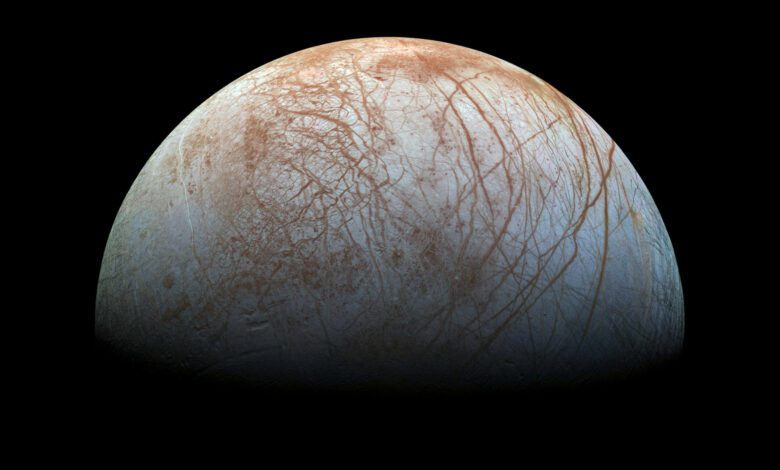
Deep beneath the icy crust of Jupiter’s moon Europa lies an ocean that has long fueled scientific imagination. A thick sheet of ice, tens of kilometers deep, separates this watery world from space, and beneath it is a rocky seabed about which catastrophically little is known. It is at the boundary of water and rock, researchers believe, that life could emerge—if it can find a source of energy. But new data now casts doubt on this optimistic scenario.
On Earth, tectonic processes on the ocean floor provide a constant influx of fresh rock—and with it, the nutrients needed to sustain life. Water penetrates deep through cracks formed by shifting plates and, interacting with hot rock, becomes rich in chemical elements. These substances are then released into the ocean through hydrothermal vents, creating unique ecosystems. But what happens on Europa?
A Model Without Hope
A team of scientists led by Paul Byrne developed a new model to estimate how likely tectonic processes are on Europa’s ocean floor. Their calculations accounted for tidal forces generated by Jupiter’s gravity, the gradual cooling and contraction of the moon’s interior, and heat convection in the mantle. However, none of these factors turned out to be strong enough to trigger fractures and rock movement comparable to those on Earth.
Tidal forces, which cause the rise and fall of sea levels on Earth, also exist on Europa. But for them to fracture the moon’s rocky floor, its orbit would need to be much more elongated than it is now. Even if tides do create cracks in the upper layers, these fractures do not extend deep enough to expose new rock.
Hydrothermal mysteries
Another possible mechanism is core contraction as it cools. Over billions of years, Europa may indeed have shrunk in size, but this was not enough to create deep faults. For comparison: throughout its history, the Moon has contracted by just a few dozen meters, while Mars has shrunk by around seven kilometers. According to calculations, Europa would have needed to shrink by several kilometers for the necessary cracks to appear, but this has not happened.
The lack of tectonic activity is bad news for those hoping to find life in Europa’s subglacial ocean. On Earth, it is hydrothermal vents—so-called “black smokers”—that supply the deep ocean with energy and nutrients. On Europa, according to the new model, such powerful vents are not possible. There is only hope for less active, colder hydrothermal systems that might exist closer to the seafloor’s surface. However, their energy potential and longevity remain highly questionable.
Searching for alternatives
If neither tectonic activity nor hydrothermal vents provide Europa with the necessary nutrients, the question remains: what other sources of energy might support life? One possibility is radioactive decay within the moon’s interior, though the scale of this process is still unknown. Another is meteorite impacts that, by penetrating the icy crust, could deliver nutrients from the surface to the ocean below. However, the thickness of the ice and lack of direct channels between the surface and ocean make this route highly questionable.
NASA’s Europa Clipper mission, already en route to the moon, could soon provide answers to these questions. The spacecraft will search for signs of material exchange between the surface and the ocean, and will assess how realistic the prospects for subglacial life truly are. For now, however, scientists must admit: Europa has turned out to be far less hospitable than optimists once hoped.
Looking ahead
The findings have prompted scientists to reconsider the prospects for other icy moons throughout the Solar System. According to Byrne, a similar situation may exist on other ocean worlds—except possibly for Saturn’s moon Enceladus, where active geysers have already been observed. Despite the pessimistic conclusions, researchers are not ready to abandon the search for life beneath Europa’s ice. Worlds with subsurface oceans remain among the most intriguing targets for future exploration.