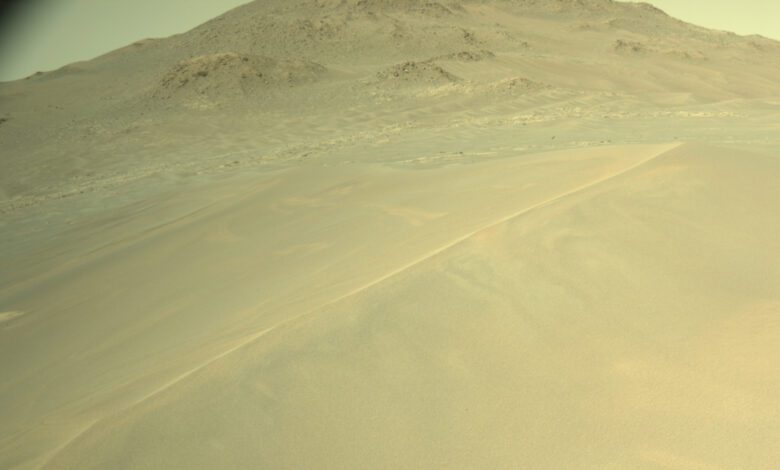
The Perseverance rover has once again amazed the scientific community: on the surface of Mars, it has discovered massive sand waves known as megaripples. These formations reach up to two meters high and appear frozen in time. Unlike familiar Earth dunes, Martian megaripples barely change even after years, and sometimes millennia, preserving traces of ancient winds and mysterious processes that once shaped the Red Planet.
Researchers note that while the Martian atmosphere is much thinner than Earth’s, winds still play a key role in shaping the landscape. Sand carried by air currents can not only create new forms, but also erode rocks, grinding them into fine particles. However, megaripples behave differently: they seem to have frozen in place, remaining immovable even in strong gusts of wind.
The secret to this stability lies in the unique surface structure. When atmospheric moisture reacts with dust, a dense crust of salts and dust forms on the crests of the megaripples. This crust literally cements the grains of sand, locking them in place. Ordinary winds can no longer shift these formations, turning them into a kind of time capsule that preserves the ancient climate conditions of Mars.
The secrets of the megaripples
Sometimes, despite their apparent stillness, some mega-ripples show signs of activity. Scientists believe that rare but powerful winds can break through the protective crust and restart the movement of sand. To test this hypothesis, Perseverance headed to an area known as Honeyguide, home to one of the most intriguing mega-ripple clusters.
The mission team focused special attention on a feature called Hazyview. Here, the rover carried out more than fifty separate observations, using its full suite of scientific tools—from the SuperCam and Mastcam-Z cameras to the MEDA, PIXL, and WATSON analyzers. Researchers tried to determine whether the mega-ripples are truly “dormant” and what conditions might awaken them.
The results of these observations could change our understanding of the Martian surface. If mega-ripples can periodically become active, it means Mars is less static even today than previously thought. This discovery is important not only for science but also for future missions: understanding the behavior of sand and dust will help better prepare for landings and operations on the planet.
Martian Sand and the Future of Missions
At first glance, studying sand waves may seem secondary compared to the search for signs of life. However, it is these details that provide deeper insights into how Mars’ surface has evolved in recent epochs. Mega-ripples are like chronicles of winds and chemical processes that once shaped the planet’s landscape.
Moreover, the chemical composition and strength of Martian soils directly impact the success of future missions. How well equipment can traverse the sand affects not only the safety of rovers but also the feasibility of extracting resources on site. Even the way dust behaves around equipment is far from trivial — it can damage mechanisms or, conversely, become a source of valuable materials.
In Honeyguide, Perseverance did more than just record data — it was literally uncovering layers of Martian history. Each analysis, every photo and spectrogram brings scientists closer to solving the mystery of how Mars became the planet we see today. And perhaps, this knowledge will one day help humans set foot on the Red Planet without fear for their technology or lives.
A look into the past
Megaripples aren’t just beautiful landscape formations. They are the key to understanding how Martian winds have changed, how water appeared and vanished, and how conditions for possible life were created. As Perseverance explores these mysterious structures, it opens up new horizons for humanity. Each new image, each analysis — is a step closer to one day calling Mars our second home.
In case you didn’t know, Perseverance is NASA’s sixth rover to land on Mars, touching down in Jezero Crater in February 2021. Its main mission is to search for signs of ancient life and collect soil samples for future return to Earth. The rover is equipped with a unique suite of scientific instruments that enable comprehensive studies of Mars’s atmosphere, soil, and climate. Over the years, Perseverance has become the source of several groundbreaking discoveries that are reshaping our understanding of the Red Planet.