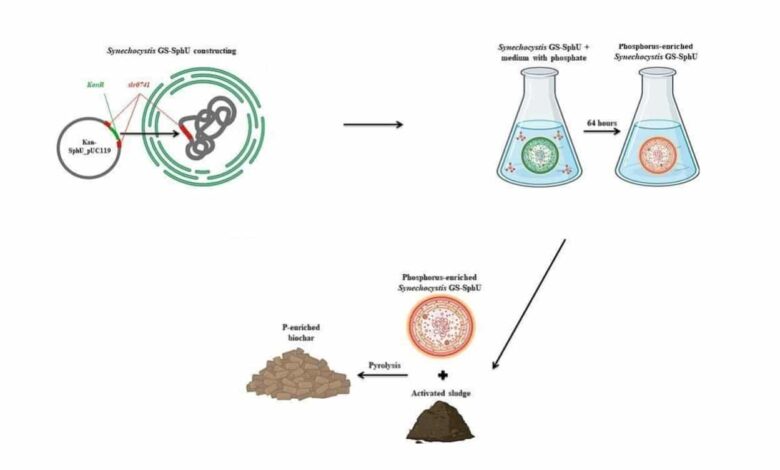
A team of Russian biotechnologists has unveiled an innovative strain of the cyanobacterium Synechocystis, capable of accumulating phosphorus from wastewater three times more efficiently than its natural counterparts. This breakthrough could mark a major step forward in combating water pollution while offering a new solution for producing environmentally friendly fertilizers.
In recent years, phototrophic microorganisms have been actively used across various industries—from biofuel production to obtaining valuable biologically active compounds. Their biomass is in demand in the food industry, as well as in pharmaceuticals for the creation of antioxidants and anti-cancer drugs. However, scientists are particularly interested in the ability of microalgae and cyanobacteria to purify wastewater by removing biogenic elements, heavy metals, and organic pollutants.
In the Synthetic Biology Laboratory at the National Research Center “Kurchatov Institute”, a genetically modified strain of Synechocystis sp. was developed that can absorb three times more phosphorus from the environment than its natural predecessors. This result was achieved by introducing new genetic constructs that enhance the transport and accumulation of phosphorus within the bacterial cells.
Technology and application prospects
The developed technology not only efficiently removes excess phosphorus from wastewater, but also allows the resulting biomass to be used for biochar production. Biochar is a product made from processed organic waste that is widely used in agriculture. Thanks to its porous structure, it improves drainage in dense soils and helps retain moisture in arid regions.
With the new strain of cyanobacteria, biochar becomes an even more valuable product: it is enriched with plant-available phosphates. As a result, each 100 grams of the final product contains up to 22.5 grams of phosphorus, significantly boosting fertilizer effectiveness. In this way, scientists have proposed a comprehensive solution to two urgent problems at once—cleaning water bodies and creating renewable sources of fertilizers.
According to the research team, the resulting strain demonstrates stable properties and can be grown on an industrial scale. This opens up wide prospects for adopting the technology in the agricultural sector and public utilities.
Environmental and Economic Benefits
The problem of phosphorus pollution in water bodies is especially acute in regions with developed agriculture and industry. Excess phosphorus leads to eutrophication—a rapid growth of algae that disrupts ecosystems and degrades water quality. A new development by Russian scientists can significantly reduce phosphorus levels in wastewater, preventing negative consequences for the environment.
Moreover, using the biomass of modified cyanobacteria to produce fertilizers helps reduce the consumption of mineral phosphate additives, the extraction of which depletes natural resources and causes significant environmental harm. Thus, the technology promotes a closed waste recycling cycle and reduces human impact on nature.
The economic impact of this innovation could be substantial: lower wastewater treatment costs, reduced fertilizer expenses, and higher crop yields.
Patent and further research
The development by the Kurchatov Institute Research Center is already patented, confirming its uniqueness and commercial potential. In the near future, scientists plan to conduct large-scale tests of the technology at industrial facilities and agricultural enterprises.
Experts note that such biotechnological solutions can be adapted for various climate zones and types of wastewater. In the future, it is possible to create entire biotechnology complexes that combine water purification, biochar production, and the manufacture of environmentally friendly fertilizers.
The implementation of these innovations will not only improve the environmental situation but also boost the competitiveness of domestic agriculture in the global market.
By the way: what is known about the Kurchatov Institute
By the way, the National Research Center ‘Kurchatov Institute’ is one of Russia’s largest scientific complexes, founded in 1943. Initially established for the implementation of the atomic project, today it conducts a wide range of research in nuclear physics, biotechnology, materials science, and information technology. The center boasts unique laboratory facilities and collaborates with leading universities and industrial enterprises worldwide. In recent years, special attention has been paid to the development of synthetic biology and the creation of new biotechnological solutions for medicine, energy, and ecology. The Kurchatov Institute has repeatedly initiated major international projects and continues to be a flagship of Russian science.