Kilometers below the Earth’s surface, in total darkness and silence, physicists have recorded a unique event: for the first time, solar neutrinos were caught as they transformed carbon-13 atoms into nitrogen-13. This breakthrough has opened new horizons in nuclear physics and given scientists fresh insights into the role of these elusive particles in the Universe.
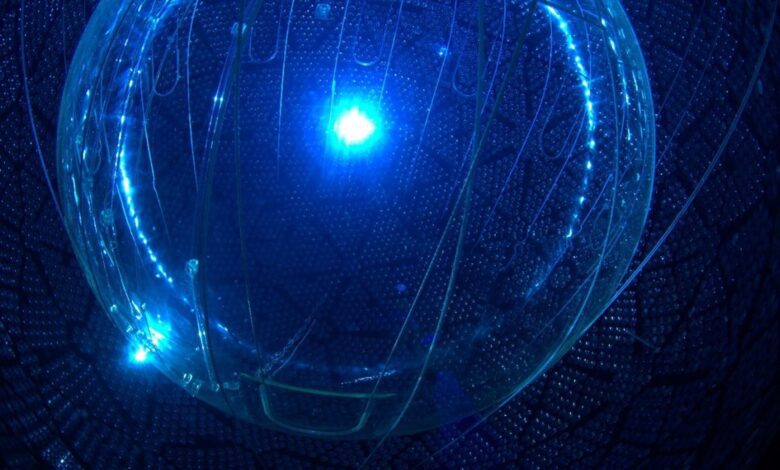
The experiment took place at the SNOLAB laboratory in Canada, located two kilometers underground. Here, shielded from cosmic rays and background radiation, researchers created ideal conditions to observe extremely rare processes impossible to detect at the Earth’s surface. Inside a massive tank filled with liquid scintillator, scientists waited for neutrinos born in the heart of the Sun to interact with carbon nuclei.
Solar neutrinos are among the most mysterious and abundant particles in the Universe. They carry no electric charge, their mass is virtually zero, and their interaction with matter is so weak that billions of these particles pass through our bodies every second without leaving a trace. That’s why they are often called ‘ghost’ particles.
A rare reaction
However, sometimes—albeit extremely rarely—a neutrino does collide with an atomic nucleus. In the case of carbon-13, this triggers a unique nuclear reaction: one of the neutrons in the nucleus transforms into a proton, and the atom becomes nitrogen-13. This process is accompanied by the emission of an electron, and after about ten minutes, the unstable nitrogen-13 decays, releasing a positron—the electron’s antiparticle.
For scientists, it was important not only to confirm that the interaction occurred, but also to track the distinctive sequence: first a flash from the electron, followed by a flash from the positron. This “double signal” became the key evidence that they were observing the desired reaction, not random noise or another phenomenon.
Over 231 days of observation, researchers detected 60 events meeting the criteria. After thorough analysis and statistical processing, it turned out that about six of them were actually caused by neutrinos, which is almost exactly what theoretical predictions forecast.
Underground technology
To achieve such accuracy, the team used advanced data filtering techniques and eliminated background signals. The depth of SNOLAB’s location plays a crucial role: massive layers of rock shield the detector from cosmic rays, while the liquid scintillator amplifies even the faintest flashes produced when neutrinos interact with atoms.
Inside the laboratory, thousands of photodetectors are installed, capable of capturing even the faintest flashes of light. Every detected signal is analyzed using special algorithms to distinguish rare events from background noise. This approach allows researchers to record even singular instances of interaction that were previously considered almost impossible to observe.
Research leader Gulliver Milton from the University of Oxford noted that, for the first time, solar neutrinos have been used as a kind of “test beam” to study other rare nuclear reactions. This opens up new opportunities for fundamental research in the field of elementary particle physics.
Significance of the Discovery
Confirming the existence of such a rare reaction not only validates theoretical models, but also sets a new standard for future experiments. Physicists now have an exact measurement of the probability of low-energy neutrinos interacting with carbon-13, which will help develop new methods to study the structure of matter and the processes occurring in stars.
Previous similar experiments earned Nobel Prizes in Physics, but now scientists are taking the next step — moving from observing neutrinos themselves to studying their impact on other elements. This could lead to new discoveries in astrophysics and nuclear chemistry.
In addition, the results of this work will help to better understand the processes occurring deep within the Sun and other stars, as well as to refine the parameters of models describing the evolution of the Universe. Each new experiment in this field brings humanity closer to uncovering the most complex mysteries of space.
The future of research
The discovery made at SNOLAB has already attracted significant interest within the scientific community. Researchers now face the challenge of broadening the range of observable reactions and increasing detector sensitivity. In the future, this will make it possible to detect even rarer events and, perhaps, discover new types of interactions that so far exist only in theory.
Further experiments are expected to not only deepen our knowledge of neutrinos, but also provide the key to understanding the processes underlying the existence of matter in the Universe. In the coming years, physicists plan to use the collected data to develop new models and conduct larger-scale research.
If you didn’t know, SNOLAB is one of the world’s largest underground laboratories, located in Canada at a depth of about two kilometers. International teams of scientists here study neutrinos and other elementary particles. The lab is renowned for its unique experiments, which have often formed the basis for major scientific breakthroughs and awards, including the Nobel Prize in Physics.