Global Records: Towers That Changed City Skylines
Modern TV towers are more than just technical structures—they have become true symbols of their cities. They shape the iconic silhouettes of major metropolises, attracting tourists and serving as platforms for daring engineering solutions. This overview highlights ten of the world’s tallest TV towers, each unique in its own right.
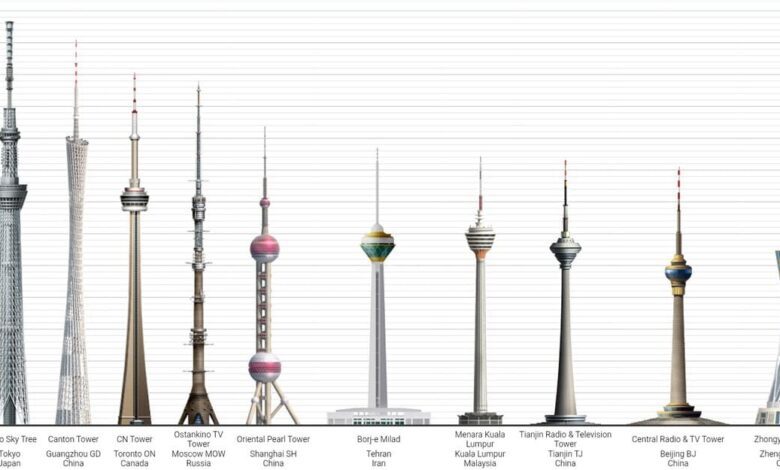
Leading the list is Tokyo Skytree (Tokyo, Japan), soaring 634 meters high. It serves as both a center for broadcasting and a popular observation deck with restaurants. The tower is a landmark of Japan’s capital and is second in height only to the famous Burj Khalifa (Dubai).
Second place goes to Canton Tower (Guangzhou, China) at 600 meters. This multifunctional structure combines telecommunications with entertainment spaces. The tower is renowned for its distinctive silhouette and nighttime illumination.
Architectural Records and Engineering Feats
The third tallest is CN Tower (Toronto, Canada), reaching 553.3 meters. Since it opened in 1976, it held the title of the world’s tallest free-standing tower for many years and still remains the tallest in the Western Hemisphere.
Ostankino Tower (Moscow, Russia) – at 540.1 meters – was the first structure in Europe to surpass the 500-meter mark. Since 1967, it has played a key role in broadcasting television and radio signals, and remains popular among tourists for its panoramic views of the Russian capital.
The Oriental Pearl Tower (Shanghai, China), standing 468 meters tall, is another iconic symbol of the metropolis. Its futuristic design attracts millions of visitors every year.
Multifunctional centers and tourist attractions
Milad Tower (Tehran, Iran), at 435 meters, serves as a hub for broadcasting, conference halls, and restaurants. Since its opening in 2007, it has become one of the main attractions of the Iranian capital.
KL Tower (Kuala Lumpur, Malaysia), at 421 meters, is the largest tower in Southeast Asia. Built from concrete, it is used not only for signal transmission but also as an observation deck offering breathtaking views of the city.
Several of the world’s top 10 towers are located in China: the Tianjin Radio and Television Tower (Tianjin, 415.2 meters), the Central Radio and TV Tower (Beijing, 405 meters), and Zhongyuan Tower (Zhengzhou, 388 meters). Each plays a vital role in the country’s telecommunications infrastructure and is open to tourists.
Engineering innovations and cultural significance
These towers not only provide communications and broadcasting services but also become focal points for locals and tourists alike. They incorporate advanced technologies, and their architectural solutions are often discussed within the professional community.
Many of these towers feature revolving restaurants, observation decks, and even exhibition spaces. This allows them to combine technical roles with cultural and entertainment functions, making these towers part of urban life.
Skyscrapers continue to inspire architects and engineers worldwide, with new records regularly set thanks to innovative projects.
Did you know? Fascinating facts about Tokyo Skytree
Tokyo Skytree is the tallest broadcasting tower in Japan and one of the country’s most iconic structures. Construction began in 2008 and was completed in 2012. The tower was built to withstand the region’s seismic activity: its unique damping system allows it to endure powerful earthquakes. Inside, there are two observation decks at 350 and 450 meters, offering panoramic views across all of Tokyo. Lower levels host a shopping mall along with numerous cafes and restaurants. Millions of tourists visit the tower every year, and its vibrant illumination at night is truly spectacular. Tokyo Skytree serves as a hub for digital TV and radio broadcasting, providing connectivity to millions of city residents. The tower has become an integral part of Tokyo’s urban landscape and a symbol of Japan’s technological progress. Its height—634 meters—is no coincidence: the numbers 6-3-4 can be pronounced as ‘Musashi’ in Japanese, the historical name of the region where the tower stands. Today, Tokyo Skytree is a must-see destination for anyone visiting Tokyo.