The dictator’s agony and a nation on edge
On the evening of November 19, 1975, a tense atmosphere gripped Madrid’s La Paz Hospital. Doctors and military officers took turns keeping vigil outside a hospital room, all aware that the outcome was inevitable. Francisco Franco, aged 82, was in critical condition. Outside, journalists and officials braced for news, while across the country, preparations for a large-scale funeral were already underway. The dictator’s last weeks passed in seclusion, without public appearances. With each passing day, it became increasingly clear: an era was drawing to a close.
During the night of November 20, Franco’s heart stopped. Attempts to resuscitate him failed. Soon after his death, government officials and military leaders began arriving at the hospital. Telephones rang non-stop in ministers’ offices and headquarters — the single word “already” could mean only one thing: the country was left without its leader.
Operation Lucero and the first political moves
Franco’s death did not catch the country’s elite off guard. For over a year, a detailed contingency plan had existed for his passing — Operation Lucero (Operación Lucero). The main objectives: prevent chaos, maintain public order, and organize the national mourning. Within hours of Franco’s death, his body was prepared for a public farewell, while in the corridors of power, the names of potential successors were already being discussed.
Prince Juan Carlos, who was 37 at the time, was among the first to be informed. Soon after, politicians began to gravitate toward him, hoping to influence the formation of the new government. Meanwhile, preparations were underway at the hospital to embalm the body so it could be displayed for public farewell. A sculptor was tasked with making a death mask, while doctors worked to preserve the deceased’s appearance.
The first hours after death: the battle for the future
While the country was still unaware of the dictator’s death, government buildings were buzzing with activity. The Council of Regency (Consejo de Regencia) was formed to temporarily govern the nation. Soon, meetings were set to take place at which Juan Carlos would be sworn in as the new head of state. At that moment, old elites tried to keep control, hoping changes would be minimal. But behind the scenes, the names of reformers were already being discussed—figures who would soon play a key role in the transition to democracy.
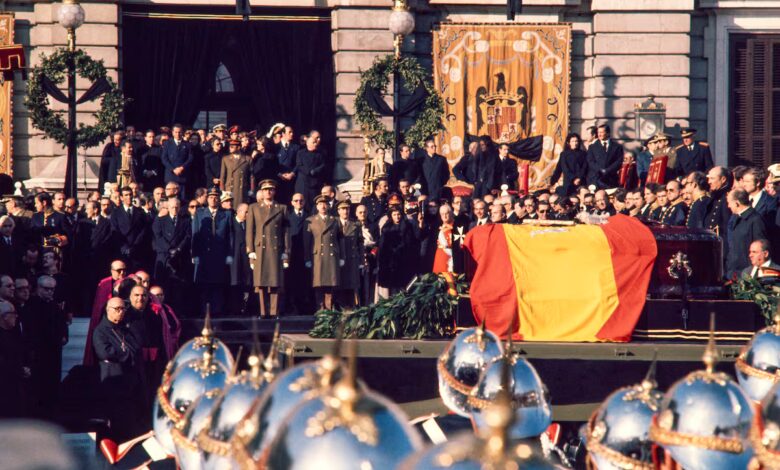
At 6 a.m., Franco’s death was officially announced on the radio. Artillery salutes began across the country. At the same time, the hospital was completing final preparations to transfer the body to the El Pardo residence, where the first funeral ceremony was held for the family and highest officials.
The dawn of a new era: first steps toward change
At the Cortes building, staff were preparing the hall for the upcoming swearing-in ceremony of the new monarch. The crown and scepter were placed at the center of the room, along with an old copy of the Gospels on which Juan Carlos was to take his oath. Shortly after the Cabinet meeting, the funeral procession set out for El Pardo, where Franco’s body was received with military honors.
The funeral was held in a small, private circle, but even at that moment it was clear: the country could not remain as it was. Power was gradually passing to new hands, and voices of change were growing louder in the streets and behind the scenes. Spain stood on the threshold of a new era, where the past still tried to hold on, but the future was already knocking at the door.