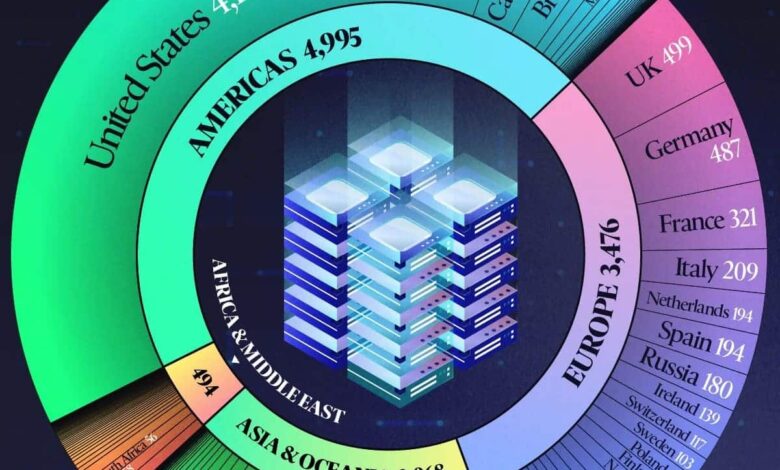
In 2025, global digital infrastructure continues to grow rapidly, and the distribution of data centers among countries is becoming increasingly unequal. The largest number of such facilities remains concentrated in the United States, which hosts more than 4,100 data centers—almost 38% of the global total. This is the result of a robust IT ecosystem, with tech companies investing heavily in cloud services and artificial intelligence.
American tech giants, including Amazon, Google, and Microsoft, are continuously expanding their computing capacities. In recent years, new players such as OpenAI have joined them, investing record amounts in infrastructure to support complex algorithms and neural networks. Investments in this sector could surpass $1.4 trillion by 2035. However, experts point out that such high levels of investment raise questions about the long-term sustainability of the market.
European Market: Growth and Regulatory Impact
Europe ranks second in the number of data centers, trailing only the US. The continent is home to around 3,500 such facilities. Leading European countries include the United Kingdom with nearly 500 data centers, Germany with 487, and France, which has 321 data centers.
The growth in the number of data centers across Europe is largely driven by stricter personal data protection requirements. The introduction of the General Data Protection Regulation (GDPR) has encouraged the development of local infrastructures, especially in northern and western regions. Companies are moving their servers closer to users to meet new privacy standards and improve data processing speeds.
Russia and other countries: ranking in the global index
Russia holds 15th place in the global ranking for the number of data centers, with 180 such facilities operating on its territory. While these figures are relatively modest compared to global leaders, the country continues to develop its own digital infrastructure to ensure independence from foreign services and meet the growing demands of both business and government.
Other regions of the world are also seeing a gradual increase in the number of data centers. Asian countries such as China and India are actively investing in their own IT platforms, aiming to bridge the gap with the US and Europe. Meanwhile, regulatory restrictions and energy efficiency issues are becoming increasingly important for operators of large data centers worldwide.
Trends and challenges: what lies ahead for the data center market
Experts note that demand for computing power will continue to grow in the coming years. The development of artificial intelligence, cloud technologies, and the Internet of Things is driving an ever-increasing need for servers and data centers. At the same time, competition for resources is intensifying, and energy efficiency and environmental sustainability are becoming top priorities.
In 2025, the distribution map of data centers reflects not only countries’ technological development but also their ability to adapt to new market demands. Leading nations are consolidating their positions, while new players are striving to find their place in the rapidly changing digital world.