The introduction of touchscreens in cars, once considered undeniable progress, is now raising more and more questions. This issue became especially pressing after the unveiling of the interior of the first electric Ferrari — the Luce, where traditional in-car displays gave way to physical controls. The approach surprised the market, particularly since the project’s lead is Jony Ive — the man who once revolutionized mobile devices with the creation of the iPhone.
The decision to move away from the excessive number of screens in the Ferrari Luce’s cabin is no accident. In Ive’s view, a car is not the place for technology to distract the driver from the road. His stance is based on real risks: numerous studies confirm that touch panels increase the likelihood of dangerous situations on the road. Unlike physical buttons, which can be found by touch, touchscreens require the driver’s eyes — and thus, attention — which is critical when driving at high speed.
The danger of distraction
In recent years, automakers have widely implemented touch displays, seeing them as symbols of technological advancement. However, experience has shown that managing the infotainment system via touchscreen forces the driver to take their eyes off the road for at least a second or two. In that brief time, a car may travel dozens of meters — and in a critical moment, that can be enough for disaster.
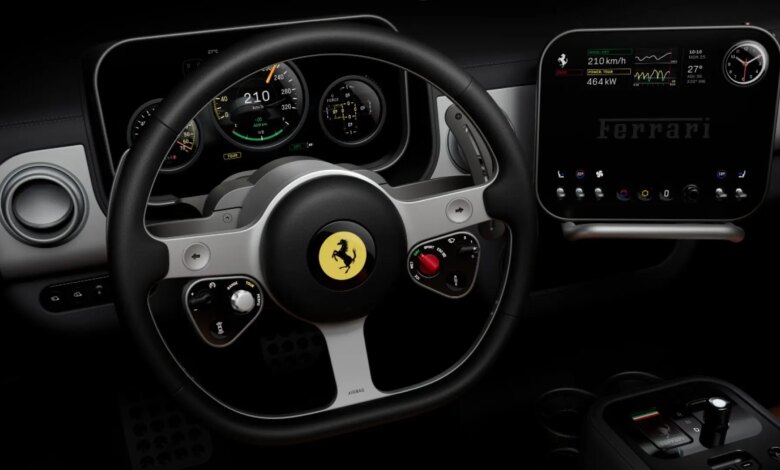
Jony Ive, despite his role in popularizing touch technology, openly states that he would never make a screen the main control panel in a car. In his view, this approach contradicts the very essence of road safety. In the Ferrari Luce, most functions are carried out through physical elements, each with a distinct tactile feel. This allows the driver to instinctively find the right button without taking their eyes off the road.
Trend or necessity
Interestingly, even Ive himself admits: touchscreens in cars have become more of a fashion statement than a conscious choice. Manufacturers rushed to introduce ever more modern solutions, not always considering the consequences. As a result, the market is now on the verge of rethinking its priorities. More and more drivers are demanding the return of traditional buttons, and some brands are already revisiting their concepts.
The Ferrari Luce is an example of a hybrid approach. The cabin features a central display, but its functions are limited, with most controls handled by physical elements. Special attention is given to ergonomics: the screen can be angled toward the driver or passenger, and beneath it there’s a convenient hand rest. This solution reduces strain on the hand and increases the accuracy of interacting with the interface.
Back to basics
The trend toward the return of physical buttons is gaining momentum. More and more manufacturers are realizing that safety and comfort are more important than blindly following trends. In the Ferrari Luce, each button has a unique shape and tactile feel, enabling the driver to quickly find controls even in challenging situations. This approach not only reduces the risk of accidents but also makes driving more enjoyable and intuitive.
At a time when driver attention has become a key safety factor, moving away from excessive touch solutions seems like a logical step. The Ferrari Luce shows that innovation can go hand in hand with traditional values when the priority is the person, not technology for technology’s sake.
The future of automotive interfaces
The arrival of the Ferrari Luce could become a turning point for the entire industry. If in the past it was thought that the future lay with fully digital interiors, now more experts speak of the need for balance. Hybrid solutions combining touch panels and physical controls can deliver both convenience and safety.
While some brands continue to chase trends, others are starting to listen to their customers. Returning to analog controls is not a step backwards, but an attempt to find a golden mean between innovation and common sense. Ferrari Luce has become a symbol of this new approach, where technology serves people and not the other way around.
Jony Ive is a British designer best known for his work at Apple, where he was responsible for the design and ergonomics of devices like the iPhone, iPad, and MacBook. After leaving the company, he founded his own studio, LoveFrom, which works on projects for leading global brands. In the Ferrari Luce project, Ive brought to life the idea of harmoniously blending innovation with classic solutions, focusing on safety and intuitive controls. His design approach continues to shape technology, setting new standards for the industry.