A car battery is a crucial component of any vehicle. Without it, even the most advanced car becomes inoperable and won’t start. That’s why choosing the right battery (AKB) directly impacts reliability and driving comfort. An ill-suited battery can cause engine starting issues, accelerated wear of electrical components, and extra expenses.
Today’s market offers a wide range of batteries: from traditional lead-acid to more advanced AGM and EFB models. However, the abundance of abbreviations, numbers, and standards on the casing can often be confusing. It’s especially important to consider the casing type—Asian, European, or American—as this determines compatibility with a specific vehicle and ease of installation.
Labeling and standards
A battery’s label provides key information about its specifications. One of the most common systems is the European EN (ETN) standard. In this system, a nine-digit code is divided into several segments and indicates capacity, design features, and starting current. For user convenience, manufacturers usually duplicate key specifications—voltage, capacity, and cold cranking amps—on the label in large print.
The battery’s production date is also crucial. It is usually encrypted in an alphanumeric code on the case, next to the terminals. The first characters indicate the week of manufacture, and the following ones refer to the year, which is determined using a special chart. Without knowledge of this system, there’s a risk of purchasing a battery that has spent a long time in storage and partially lost its properties.
In addition to EN, other standards are used: the domestic GOST, German DIN, and American SAE. They differ in methods of measuring starting current, so the nominal values may look the same, but the actual output will vary. This is especially important to consider when choosing a battery for foreign-made vehicles.
Internal structure of the battery
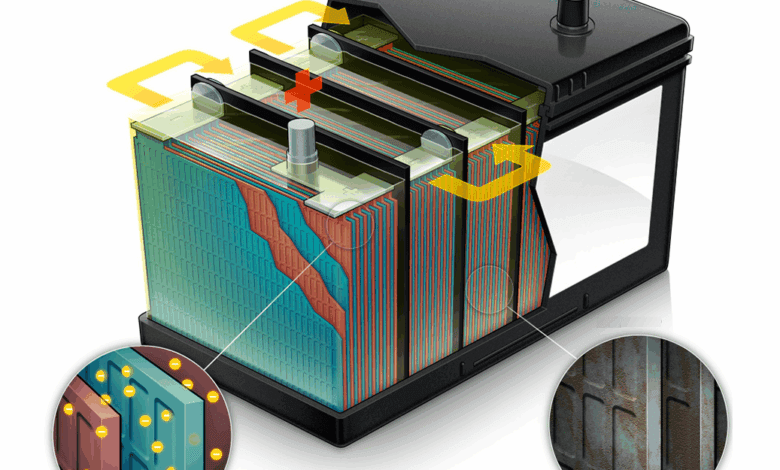
At the heart of any lead-acid battery is a chemical reaction between lead plates and electrolyte. A classic battery consists of six cells connected in series, each supplying 2 volts. Failure of even a single cell makes the whole battery unusable.
Serviceable models allow you to monitor the electrolyte level and add distilled water if necessary. Modern low-maintenance and maintenance-free batteries (SMF, VRLA) are sealed and do not require regular intervention.
According to their design, batteries are classified as:
WET — with liquid electrolyte
EFB — with reinforced electrodes
AGM — with electrolyte absorbed in fiberglass
Ca/Ca — calcium
Hybrid (Ca+)
Gel (GEL) starter batteries are rarely used due to their relatively low starting currents and are more often found in traction systems. AGM and EFB batteries are optimal for vehicles with a start-stop system and are resistant to deep discharges. Calcium batteries deliver high starting currents but are sensitive to prolonged downtime without recharging.
Casings: Asia, Europe, America
Differences between Asian, European, and American standard batteries lie not just in polarity, but also in the case design and terminal type.
European standard — terminals are recessed into the lid of the case, allowing for compact installation under the hood.
Asian standard — terminals extend above the case (‘ears’), which can make the total battery height reach up to 22 cm.
American standard — side threaded terminals for bolt connection.
Dimensions also vary: European and American batteries are usually 17.5–19 cm in height, while Asian batteries are taller. These parameters are important to ensure proper battery mounting and to prevent contact with metal car body parts.
Practical recommendations for choosing
Battery capacity should be selected according to engine size:
1.0–1.5 L — 50–55 Ah
1.5–2.0 L — 60–65 Ah
It is acceptable to choose a battery with a reserve of 5–15 Ah, especially if you use your car in cold climates or if it is equipped with a lot of electronics. Insufficient capacity can cause starting problems and reduce battery lifespan.
It is also important to consider the battery standard and the terminal diameter. If the formats do not match, adapters may be required, which is not always convenient or reliable. The best option is to choose a battery that fully meets the factory specifications of your vehicle.
Modern technologies and manufacturers
Modern batteries are resistant to vibrations, temperature fluctuations, and have low self-discharge rates. AGM models can be installed at an angle, while calcium and hybrid batteries are highly resistant to corrosion and offer a long service life when properly maintained.
If you didn’t know, Banner is one of the oldest European battery manufacturers, founded in Austria in 1937. Bosch is widely known for its innovations and high-quality automotive electronics, while Hankook (AtlasBX Co. Ltd) from South Korea has become one of the leaders in the start-stop battery segment in recent years. These brands cover virtually all types of passenger cars and meet modern standards for reliability and safety.