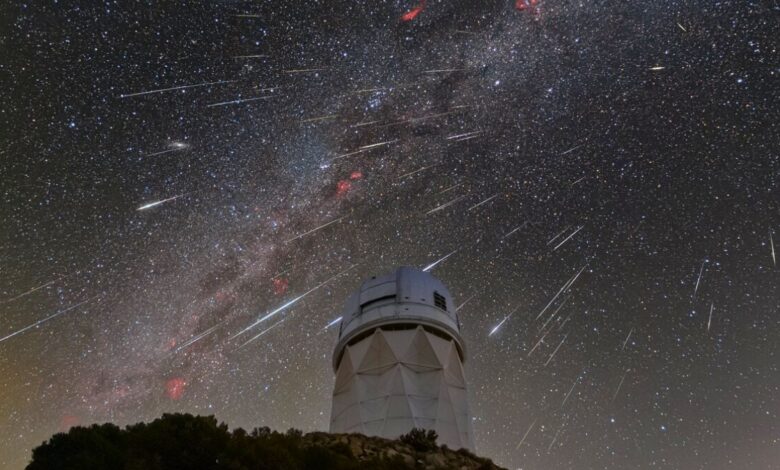
December traditionally brings not only the anticipation of the holidays, but also one of the year’s most spectacular astronomical events. This month, residents of the Northern Hemisphere will have the chance to witness two powerful meteor showers, one after the other. In 2025, special attention is on the Geminids, peaking during the night of December 13 to 14. During this time, the sky seems to explode with fiery streaks as up to 150 meteors may fall every hour.
The Geminids are considered one of the brightest and most impressive meteor showers. They stand out not only for their intensity but also for the unusual colors of their flashes. Unlike the better-known Perseids of August, this December meteor shower often surpasses them in both beauty and richness. This year, viewing conditions will be especially favorable: the Moon will be in a waning crescent phase and won’t wash out even the faintest meteors.
Stream features
The Geminids are unique in their origin. Their parent body is the asteroid 3200 Phaethon (3200 Phaethon), which has characteristics of both an asteroid and a comet. As it moves along its elongated orbit, Phaethon sheds particles that form the meteor stream. When Earth crosses this trail, the particles enter the atmosphere and burn up, leaving bright streaks across the night sky.
The shower gets its name from the fact that its radiant—the point from which the meteors appear to originate—is located near the constellation Gemini, just above the star Castor. This makes it easy for observers to know where to look so they don’t miss a single meteor streak.
How to watch
You don’t need any special equipment to watch the meteor shower. Just find a spot away from city lights where the sky is as dark as possible. The best time to observe meteors is after midnight until dawn, when the radiant rises higher above the horizon. This year, peak activity is expected around 08:00 UTC (3:00 a.m. EST), but bright meteors will be visible throughout the night.
Geminids move relatively slowly, making them easy to spot with the naked eye. They rarely leave long glowing trails, but often impress with their vivid colors—ranging from white and yellow to green and blue. Amateur photographers can capture stunning images if they prepare a tripod in advance and choose the right camera settings.
What else to expect
After the Geminids, early January brings the peak of the Quadrantids—another prominent meteor shower. However, in 2026, its maximum will coincide with a full moon, making viewing much more difficult. That’s why December’s meteor shower is the best chance to catch a real cosmic show before spring, when the Lyrids take the stage.
If the weather lets you down on the peak night, don’t be discouraged: Geminid activity lasts for several days before and after the peak. The main thing is to pick a clear night and remember to dress warmly, as December nights can be quite chilly.
Tips for Observers
Before heading out to hunt meteors, check the weather forecast and choose a spot with minimal light pollution. City lights and a bright Moon can significantly reduce the visibility of faint meteors. The best way to watch is lying on your back or in a comfortable chair, so you can take in as much of the sky as possible.
Don’t forget to bring warm clothes, a thermos with a hot drink, and maybe some like-minded friends. Meteor showers are a great excuse to spend a night in nature and enjoy the beauty of the cosmos away from city life.
In case you didn’t know, the Geminids are one of the most reliable and predictable meteor showers, delighting astronomers and enthusiasts around the world every year. Their parent body, the asteroid 3200 Phaethon, was discovered in 1983 and still intrigues scientists due to its unusual properties. Every December, millions of people head outside to witness this spectacular event. Don’t miss your chance to see this cosmic show with your own eyes!