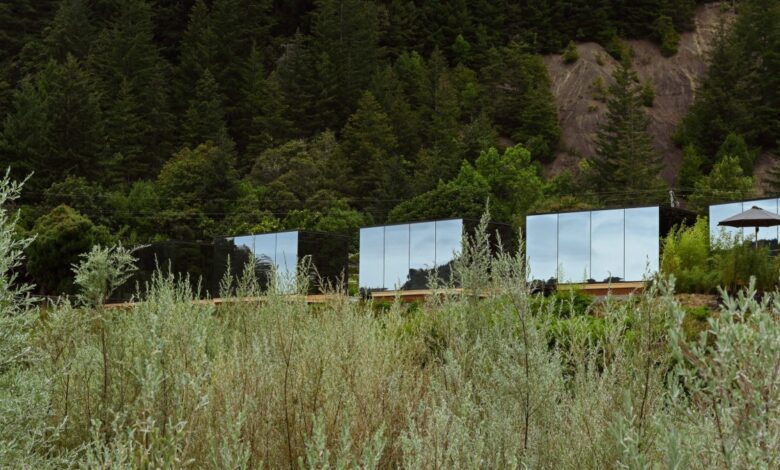
A remarkable architectural trend is gaining popularity worldwide, allowing buildings to literally disappear into their surroundings. Instead of conventional walls, mirror panels are used to reflect trees, mountains, and clouds, creating the illusion of complete unity with nature. This concept has been brilliantly realized at the historic Tu Tu’ Tun Lodge, located in a picturesque corner of Oregon, USA, on the banks of the Rogue River amid majestic mountains.
This hotel, which first welcomed guests back in the 1970s, has recently undergone a major renovation under new management. The highlight of the update is a set of twelve futuristic cabins that blend into their environment like chameleons. This approach is especially valued in rural and eco-tourism, where minimalist design and understated visuals allow guests to feel part of the wilderness without disturbing its harmony.
These unique structures offer guests more than just a place to stay—they present an entirely new way to connect with the world around them, where the line between man-made comfort and pristine beauty becomes almost invisible.
Mirror illusion
Twelve new cabins, designed by ÖÖD, have been expertly positioned along a hillside where a trailer park once stood. Three of the four walls of each cabin are entirely covered with mirrored panels. This technique lets the structures literally blend into the landscape, reflecting the starry sky at night, drifting clouds during the day, dense forest, and the calm surface of the River Roug. Guests experience complete immersion in nature, with panoramic, unobstructed views from their windows.
The only opaque wall, finished with wooden boards, conceals the entrance, adding intrigue and highlighting the contrast between natural materials and modern technology. The structures appear as an integral part of the landscape rather than foreign elements, making a stay here truly secluded and meditative.
Comfort and seclusion
Each cabin is designed for the comfortable stay of two people, ensuring total privacy. Floor-to-ceiling panoramic windows are lightly tinted from the inside and fully mirrored on the outside. This allows guests to enjoy the view while remaining completely out of sight. Inside, space is organized to be as compact and functional as possible.
Here you’ll find everything you need for a comfortable stay: a cozy double bed, a full bathroom, a dressing table, a wardrobe, and a small table with chairs. Outside, each cabin features a private terrace with a welcoming fireplace—perfect for spending evenings enjoying the sunset or listening to the soothing sound of the river. It’s the ideal escape for those seeking peace and a chance to connect with themselves and nature.
Total immersion
In addition to private cabins, the complex offers a shared sauna, also finished with mirrored panels. It’s wood-fired, allowing guests to alternate between intense heat and refreshing dips in the cool river, heightening sensory experiences and promoting deep relaxation. The entire ensemble is seamlessly integrated with the hotel’s main building, which has preserved its traditional rustic style with abundant wood, while receiving fully updated, modern interiors.
The main building, inspired by the natural textures of the Pacific Northwest, houses 18 rooms, two suites, and four separate houses designed for larger groups or extended stays. The gastronomic experience is provided by a signature restaurant led by chef Derek Piva, who embraces a ‘nature-to-table’ philosophy—using local, seasonal ingredients and focusing on sustainable cuisine. However, despite the project’s appeal, it has drawn criticism from some who are concerned about the safety of the mirrored walls for local birds, which may not see the barriers and risk colliding with them.
Incidentally, the company ÖÖD, which developed the mirrored house design, was founded in Estonia. It specializes in creating small-format modular prefabricated structures that blend seamlessly into the natural landscape. The brand’s philosophy is to bring people closer to nature for living and working, without sacrificing modern comfort. Their projects—whether hotel rooms, guesthouses, or remote offices—are popular worldwide for their innovative design and high-quality construction.