In the heart of the Picos de Europa National Park in Cantabria lies a route that has become legendary among climbers — Vía Maraya. Tracing the wall of Torre de los Horcados Rojos, it is considered one of the most iconic and sought-after ascents in the region. This is more than just a technical climb; it is a chapter in the history of Spanish climbing, combining challenge, beauty, and a spirit of innovation.
The route was opened in 1967 thanks to the efforts of José Rubio and Javier Sáenz. At the time, their approach was truly revolutionary. Before them, it was believed that the sheer walls of the central massif could only be tackled with extensive use of fixed gear. The pioneers, however, introduced a different style: they sought out natural weaknesses in the rock and proved that it was possible to climb freely, maintaining both elegance and safety. This achievement changed the philosophy of ascents in the Cantabrian mountains and inspired an entire generation of climbers.
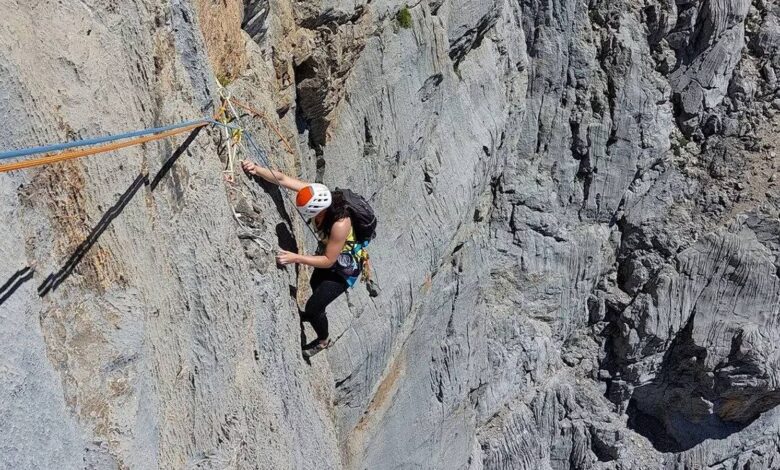
Vía Maraya is approximately 200 meters long, with a maximum difficulty grade of 6a. The route is demanding right from the start. The first section already requires overcoming a challenging crux to reach an athletic dihedral. Verticality accompanies climbers throughout the climb, creating a constant sense of exposure and height. Every meter demands complete focus, leaving no room for error.
One of the most memorable moments is the traverse on the third section. It allows climbers to bypass overhanging rocks by skillfully using their feet on abrasive rock. Despite the challenge, the solid wall inspires confidence. Here, the sensation of emptiness beneath your feet blends with the stunning surrounding landscape, offering climbers an unforgettable experience.
Climbers who have completed the route describe it as a “modern classic,” noting the high quality and grip of the compact rock, as well as the logical line. It’s no surprise that Vía Maraya has become one of the most popular routes in the central massif. Many use it as preparation before taking on more serious challenges, such as the west face of Naranjo de Bulnes or the south face of Peña Santa.
The climb finishes with an athletic inside corner which, despite its difficulty, rewards climbers with one of the most breathtaking panoramas in the Cantabrian Mountains. From the summit, there’s an unrivaled view of the valley and nearby peaks that fully justifies all the effort invested.
When planning your ascent, keep in mind that the approach to the start of the route begins from the upper station of the Fuente Dé cable car and takes about 1 hour and 45 minutes. The climb itself lasts approximately four hours, with the descent taking another half hour. The route requires skills in setting up your own protection, although there are fixed pitons and bolts on some sections. For experienced climbers confident at the 6a level, this ascent will be a vivid and rewarding experience.