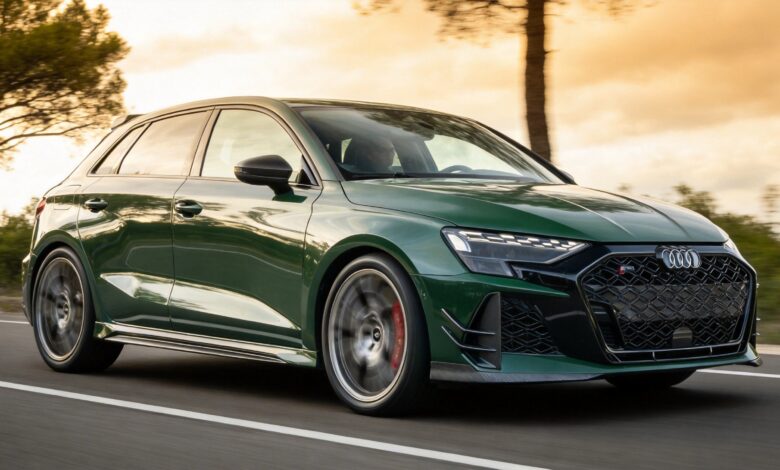
In 2026, only 25 units of the Audi RS 3 competition limited will be released on the Spanish market—this is the rarest version of the compact sports car in the brand’s history. This exclusive launch celebrates the anniversary of the five-cylinder engine, a signature feature that has shaped the character of many Audi models. For collectors and German car enthusiasts, this is more than just another release—it’s a chance to own a unique car with heritage and a distinctive sound.
Each of the 750 cars produced worldwide stands out not only for its technical features but also for its unique design details. The Spanish market will receive cars in three colors: 15 in Daytona Grey, 8 in Malaquita Green, and just 2 in Glaciar Matte White. The color selection is fixed in advance, so interested buyers should act quickly to reserve their preferred option. Prices start at €135,000, making this one of the most expensive compact sports cars available in the country.
Exterior details
The Audi RS 3 competition limited stands out from other models at first glance. The distinctive Singleframe grille, matte carbon elements on the spoilers, mirror housings, side skirts, and rear wing, along with unique 19-inch Neodimio gold-finish wheels, all highlight its exclusivity. The rear windows are tinted, while Matrix LED headlights feature a darkened design and a signature animation: when locking or unlocking, the light segments illuminate in the 1-2-4-5-3 sequence, referencing the engine’s cylinder firing order.
The interior features a dominant palette of black, gold, and white. The center sections of the sports seats are upholstered in gold-toned Dinamica microfiber, while the side inserts are finished in black leather. The seatbacks are made of carbon fiber, and an individual vehicle number is displayed on the panel in front of the gear lever. When the doors are opened, the inscription “RS 3 competition limited” is projected onto the asphalt, emphasizing the exclusive status of this limited series.
Technical specifications
The main pride of this version is its five-cylinder 2.5-liter engine, delivering 400 hp and 500 Nm of torque. The unique 1-2-4-5-3 firing order produces a signature sound that has become legendary among Audi enthusiasts. To enhance the acoustic effect, engineers reduced the firewall sound insulation and added an RS sports exhaust system, allowing the engine sound to be clearly heard inside the cabin.
The dynamics are impressive: acceleration from 0 to 100 km/h takes just 3.8 seconds, and the top speed reaches 290 km/h. For the first time in the RS 3, a coilover-type suspension with a new rear stabilizer bar has been introduced—combined with a torque splitter and ceramic brakes, this ensures maximum handling precision and stability at high speeds. The front shock absorbers are made of stainless steel, while the rears are aluminum, improving component cooling and durability.
Handling and options
The rear stabilizer bar is now thicker and stiffer than in the standard version, and the rear spring stiffness has been increased to 80 N/mm. This has improved cornering stability and steering precision. For those who want to maximize the car’s potential on the track, there is an optional installation of Pirelli PZero Trofeo R semi-slicks, which noticeably enhance grip and acceleration.
Amid growing competition among compact-class sports models, Audi is betting on a combination of tradition and modern technology. This approach has already brought success to other brand models, as shown by the analysis of Nissan Qashqai and Honda ZR-V sales in the Spanish market, where unique features and limited editions often become the deciding factor for buyers.
The Audi brand has long been associated with innovation and sporting spirit. The five-cylinder engine first appeared in 1976 and has since become a symbol of the company’s engineering excellence. Over decades, it has been repeatedly refined, and its distinctive sound is recognizable even to those not familiar with motorsports. The limited edition RS 3 competition limited is not only a tribute to history, but also a demonstration of how tradition can be combined with advanced technology and exclusive design.