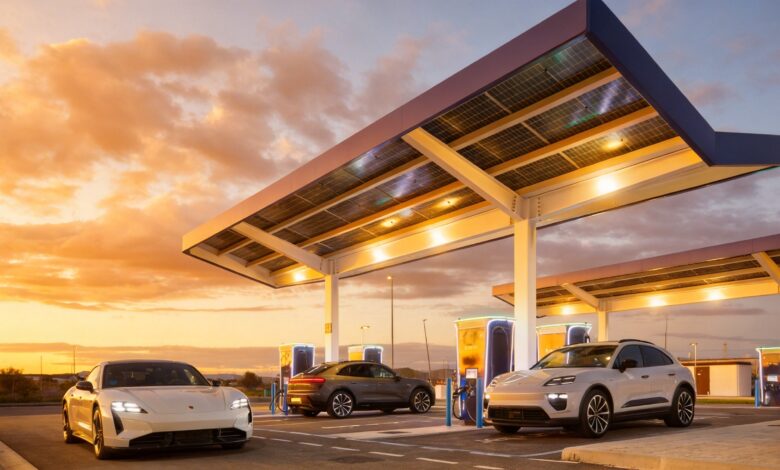
In the coming years, Spain is preparing for a significant leap in electric vehicle infrastructure. A pilot project has already been approved to create eight new service areas with ultra-fast charging stations on the country’s five busiest highways. This initiative aims to eliminate the main barrier to mass electric vehicle adoption: the fear of running out of charge far from the city. According to Autobild, the government is allocating 94.5 million euros to the project to make long-distance electric car journeys as convenient as those in gasoline vehicles.
The plan covers key routes connecting the largest cities and regions. On the A-2, linking Madrid, Zaragoza, and Barcelona, a new service area will be built near Calatayud (km 234). On the A-3, which leads from Madrid to Valencia, two stations are planned: Perales de Tajuña (km 35) and Saelices (km 99), with the latter accessible from both sides of the highway. On the A-4, connecting the capital with Andalusia, a major area will appear in Montoro (km 353), also with access from both directions.
Mediterranean route
Coastal routes are also receiving special attention. On the AP-7, one of the main roads along the Mediterranean Sea, stations will be installed in Algemesí (km 541, Valencia) and La Roca del Vallès (km 129, Barcelona), both with chargers available in both directions. To the north, along the A-8, service areas will be placed in La Caridad (km 490, Asturias) and Penagos (km 208.5, Cantabria), with the latter serving traffic in both directions.
The selection of these particular routes is no coincidence: they are traditionally overloaded during holiday and vacation periods, and queues at charging stations here have already become a common sight. The new stations are expected to solve the problem of vehicle congestion and speed up the charging process. Drivers will be able to recharge their batteries during a regular rest stop, which is especially important for family trips and business routes.
Comfort and speed
Each new zone will be more than just a charging point; it will be a full-fledged service complex. Cafés, restaurants, rest areas and other amenities will be provided so the wait doesn’t feel tiring. Thanks to chargers with a minimum power of 150 kW, most modern electric cars will be able to gain a substantial range in just a few minutes. Even vehicles that don’t support these power levels will still be able to charge at their maximum possible speed.
However, despite the project approval and completed feasibility studies, the actual launch of the stations is still a long way off. Tender processes and the selection of construction contractors are still ahead, and this procedure is rarely quick in Spain. According to experts, the first stations are unlikely to be operational for at least a few years.
Market and prospects
The introduction of ultra-fast chargers on major highways could become a turning point for the electric vehicle market in the country. Many potential buyers still hesitate to switch to electric vehicles due to insufficient infrastructure. As Autobild points out, the lack of powerful charging stations is often the decisive argument against purchasing an EV. Similar issues are being discussed in other European countries as well—for example, in the article on the development of MAN electric trucks, it is noted that without large-scale construction of charging points, a mass switch to electric vehicles is impossible.
In Spain, authorities are betting that the new stations will not only ease drivers’ concerns but also accelerate the renewal of the vehicle fleet. In the long run, this should reduce emissions and make roads safer and quieter. However, as experience shows, even the most ambitious projects require time and persistence to become reality.
The Ministry of Transport and Sustainable Mobility (Ministerio de Transportes y Movilidad Sostenible) is the key government body responsible for developing Spain’s transport system. In recent years, the agency has actively invested in eco-friendly technologies and infrastructure so the country can meet European standards for emission reductions and the transition to clean energy. Thanks to new initiatives from the ministry, Spain is gradually becoming a leader in the rollout of electric mobility in southern Europe.