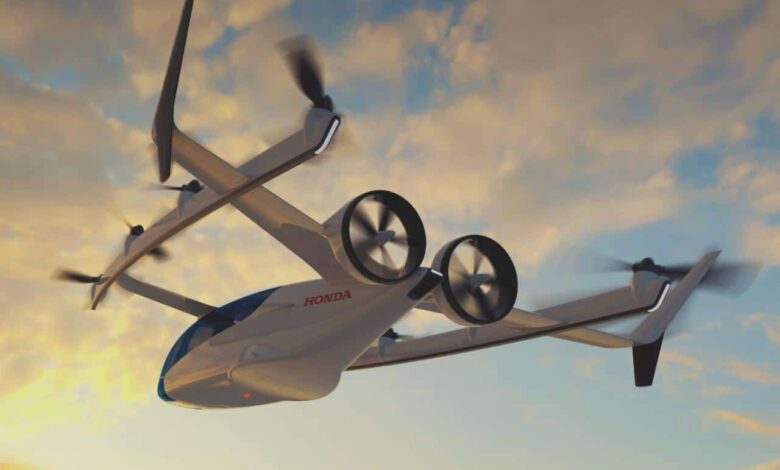
Japanese automotive giant Honda has announced plans to conduct the first test flight of its electric vertical takeoff and landing (eVTOL) aircraft in March 2026. This new development stands out among competitors thanks to its hybrid powertrain, which allows it to cover up to 400 kilometers on a single charge. This significantly exceeds the range capabilities of most current eVTOLs that run solely on batteries. Honda’s engineers believe this approach will open new horizons for urban and suburban mobility, as well as broaden the scope of air taxi applications.
Honda’s project has already attracted the attention of industry professionals. The aircraft was awarded the prestigious Red Dot Design Concept Award for its innovative powertrain architecture and a thoughtfully designed cockpit that offers improved visibility for both pilot and passengers. Experts note that the combination of electric propulsion and a compact internal combustion generator not only delivers greater range but also operational flexibility—a key advantage for use in urban environments.
Technology and Future Prospects
In the coming years, Honda plans to focus on refining the prototype and preparing for certification. The company anticipates that, by the 2030s, the eVTOL will enter the market and become part of the urban transportation system. Honda emphasizes that the hybrid setup will allow the aircraft to operate in areas with limited charging infrastructure and provide backup power in emergency situations.
Unlike fully electric models, Honda’s hybrid eVTOL can fly longer distances without the need for frequent recharging. This opens up possibilities for intercity routes and operation in regions with limited access to power grids. Additionally, engineers have prioritized safety: the flight control system features backup communication channels and automatic monitoring of all key components.
Design and passenger comfort
The project pays special attention to ergonomics and comfort. The Honda eVTOL cabin is designed for maximum visibility, enhancing safety and making piloting easier. The interior accommodates several passengers, and cabin noise is reduced thanks to efficient soundproofing and optimized aerodynamics.
The company’s designers aimed to create not only a functional but also an attractive exterior. The streamlined lines of the body, integrated lighting elements, and modern materials emphasize the innovative nature of the aircraft. Honda representatives say this approach will help draw in potential customers and speed up eVTOL adoption in daily life.
Future plans and challenges
Honda faces the challenge not only of completing testing, but also of going through a complex certification process required to enter the market. The company is actively working with aviation regulators and developing safety standards for new types of air transport. Honda is confident their hybrid eVTOL can set new industry standards and serve as a benchmark for other manufacturers.
At the same time, work is underway to create the infrastructure needed for the maintenance and operation of these aircraft. Plans include organizing service centers, training pilots, and integrating eVTOL into the existing transportation systems of major cities. The first commercial flights are expected to be possible as early as the beginning of the next decade.
Worth noting: Honda is a global leader in innovation
Honda is one of the world’s largest manufacturers of cars and motorcycles, founded in 1948. The company is renowned not only for its vehicles, but also for its active work in robotics, aviation, and energy. The brand’s portfolio includes its own line of HondaJet business jets, as well as numerous developments in electric transport and autonomous control systems. Honda traditionally focuses on green technologies and sustainable development, investing significant resources in research and the implementation of new solutions. In recent years, the company has repeatedly won international awards for design and innovation. The introduction of eVTOL is a logical extension of Honda’s strategy to strengthen its presence in the urban mobility sector of the future.
It is worth noting that recently, California hosted tests of NASA’s experimental X-59 supersonic aircraft. The plane successfully completed key checks at an altitude of 3.6 kilometers. You can learn more about this topic in our previous report.