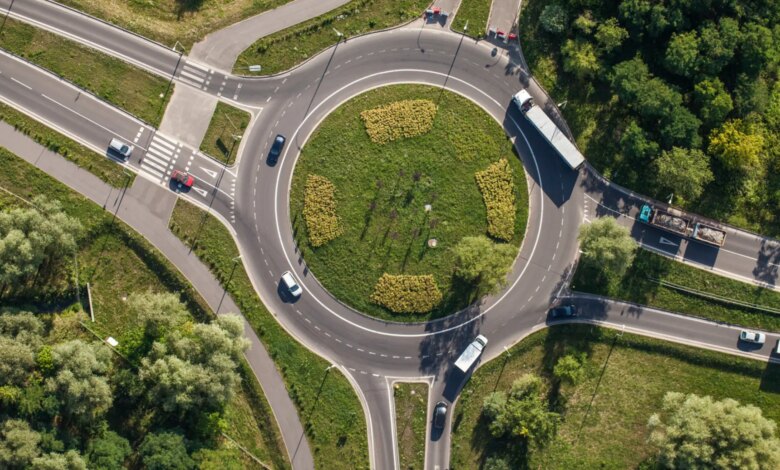
Roundabouts, or so-called “circles,” appeared in Spain in the second half of the 20th century. The first such structure was built in 1976 in Palma de Mallorca, following the French model where priority is given to vehicles already on the roundabout. Since then, the number of these intersections in the country has increased significantly, and today you can find at least one roundabout in almost every city.
The main purpose of these roundabouts is to improve safety at road intersections and reduce the number of accidents. However, despite their widespread use, many drivers still do not always follow the rules for navigating them, leading to dangerous situations on the roads.
According to current traffic regulations, when entering a roundabout, drivers must yield to vehicles already circulating on it. Violating this requirement is considered a serious offense. Entering a roundabout without yielding or ignoring the “give way” sign carries a fine of 200 euros and the deduction of four points from the driver’s license.
Furthermore, if a driver commits a violation while already on the roundabout—such as failing to yield when changing lanes or exiting—this can have more serious consequences. In such cases, the fine can reach up to €500, and the number of penalty points increases to six. In some instances, these actions may be classified as a crime against road safety.
To drive safely on a roundabout, it’s important to follow a few simple rules. First, always yield to vehicles already on the roundabout. Second, drive counterclockwise. Third, always use turn signals when changing lanes or exiting the roundabout. It’s recommended to enter and exit using the right lane to avoid conflicts with other road users.
Interesting fact: the largest roundabout in Spain is located in the province of Badajoz. It encircles the Masatrigo hill, which rises 400 meters in the middle of the La Serena reservoir, the largest by volume in the country. Although this section is not officially designated as a roundabout, its circular shape and 1,300-meter length make it unique. The road has a single lane and two interchanges in the form of bridges crossing the reservoir. This unusual landmark is part of the EX-322 route.
Thus, roundabouts have become an integral part of Spanish roads, and following the rules for navigating them is essential for everyone’s safety. Violations in these areas are strictly penalized, so drivers should be especially attentive and disciplined.