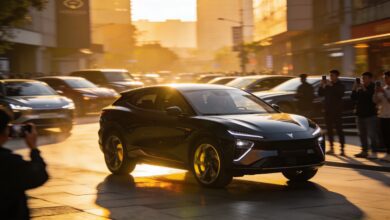
China’s electric vehicle market is undergoing a real transformation: the Xiaomi SU7 2026 sold 15,000 units in the first 34 minutes of sales. The strong demand is not only due to its attractive price, but also because the updated model offers technological features previously found only in the premium segment. European manufacturers are losing ground, while Chinese brands are setting new standards—already resulting in a noticeable decline in the local market share of German automakers.
In China, the SU7 2026 is available in three versions: Standard, Pro, and Max. The base model starts at 219,900 yuan (about €27,547), while the top-end Max is priced just above €38,000. Ordering requires a 5,000 yuan deposit, or about €626 at the current rate. Customers can adjust their configuration until March 22, offering flexibility in choosing options.
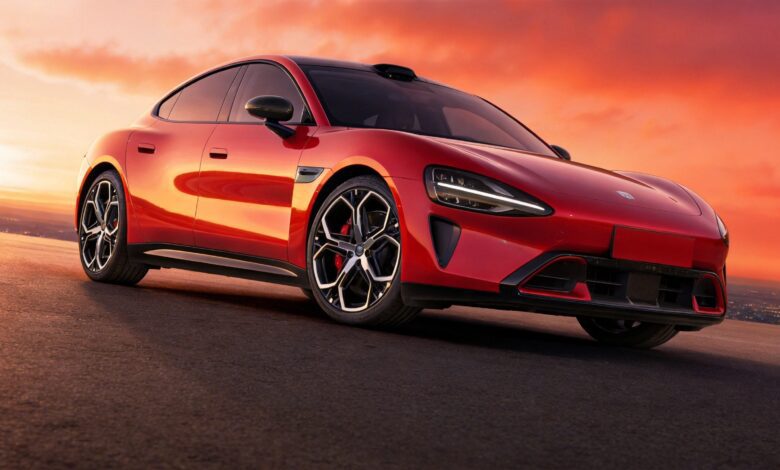
Exterior updates include a new grille with an integrated 4D radar, a high-pressure camera cleaning system, tinted mirrors, 21-inch forged wheels, and red brake calipers. The color palette has been expanded to nine options, with an exclusive Cabrio Blue shade available for the Max. Inside, the standard features now include black Dark Night trim, three-level ambient lighting, and a Nappa leather steering wheel. The front seats are 18-way adjustable with massage and side support, while the rear seats offer a ‘zero gravity’ function and new headrests. The Max version adds a panoramic two-zone sunroof with intelligent dimming.
Technology and autonomy
All SU7 2026 versions are equipped with a V6 Plus motor with 94% efficiency. The Max accelerates from 0 to 100 km/h in 3.08 seconds and reaches a top speed of 265 km/h. The driving range on the Chinese CLTC cycle is 720 km for the Standard, 902 km for the Pro, and 835 km for the Max. Keep in mind that these figures are typically higher than those based on the European WLTP standard. The SiC platform supports 752 V for the Standard and Pro, and 897 V for the Max, enabling up to 670 km of charge in just 15 minutes or replenishing the battery from 10% to 80% in only 12 minutes.
Equipment includes 14–25 speakers with Dolby Atmos, a 4.4-liter refrigerator with a temperature range from -6 to 50 °C, as well as support for 5G, UWB, and Wi-Fi 7. The SU7 features integrated Super XiaoAI and a cognitive XLA system based on the third-generation Snapdragon 8 and an additional 700 TOPS processor. Thanks to OTA updates, these functions are also available for previous SU7 models.
Chassis and safety
The model is built on the proprietary ‘Dragon Chassis’ with double-wishbone front suspension and independent five-link rear suspension. Air suspensions with dual chambers and variable stiffness CDC are added in the Pro and Max versions. All variants come with 265 mm wide rear tires. The standard package includes 25 driver assistance systems, and the Max version additionally features nine airbags, reinforced steel beams, integrated safety frames, and triple door handles.
As Car News China notes, the rapid launch of SU7 2026 sales became a warning sign for European automotive giants. Amid this success, Xiaomi is already preparing to launch the sporty SUV YU7 GT with up to 990 hp and a CLTC range of 705 km, which is expected to complement the SU7 lineup and strengthen the brand’s market position.
Market impact
The situation with the Xiaomi SU7 2026 clearly shows how Chinese manufacturers are shifting the balance of power in the automotive industry. European brands are forced to respond to new challenges by lowering prices and accelerating the introduction of innovations. According to russpain.com, the success of Chinese models has already prompted competitors to revise their strategies, while buyers are increasingly choosing local brands for their combination of price, technology, and features.
In this context, it’s worth noting how hybrid and electric models from other countries are trying to compete with Chinese cars. For instance, the Swedish Volvo XC70, which boasts record-breaking range and a hybrid system, has already raised concerns among European manufacturers—a topic explored in detail in the article on the impact of new Volvo hybrids on the European market.
Xiaomi is one of China’s largest technology brands, which in recent years has expanded far beyond the smartphone and consumer electronics market. The company is heavily investing in electric vehicle development, focusing on integrating its digital platforms and unique solutions for safety and comfort. Thanks to an aggressive pricing strategy and quick adaptation to customer demands, Xiaomi has not only taken leading positions in its home market but has also created serious competition for global automotive giants. The SU7 became the brand’s first mass-market electric car, and its success in China has already led many European companies to reconsider their strategies.