In many Spanish homes, balconies are a rare slice of outdoor space, yet neighboring windows can leave them feeling exposed. As summer approaches and life moves outside, the challenge is to enjoy fresh air and sunlight without feeling on display. The right barrier can add privacy while preserving daylight and the balcony’s open feel. Airflow can remain unobstructed.
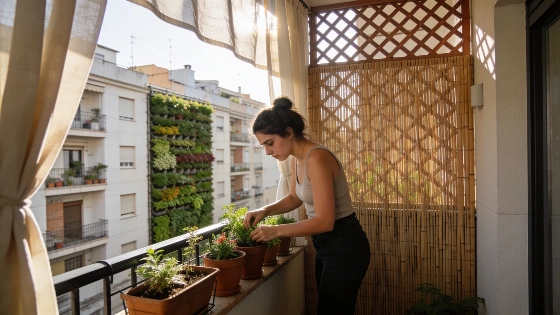
Bamboo screens remain a popular, affordable fix. These rolls attach to railings with cable ties or wire and come in natural or PVC versions. Their neutral look suits many styles, and they’re easy to install, making them useful for renters or anyone seeking a quick upgrade. Before attaching anything to a railing, check the building’s rules and make sure the screen is securely fitted.
Outdoor privacy fabric offers another lightweight option: it wraps around balcony railings to reduce views and is easy to remove. Lattices provide a more structured barrier and come in wood or PVC, with aluminum models also available. Their open pattern lets air and light pass through, and they can support climbing plants for added greenery. A lattice fixed to a façade or another shared building element, but, differs from a removable screen and may require approval.
Fixed and Flexible Barriers
Opaque or translucent glass panels can reduce visual exposure while letting daylight into the balcony. Profile-free glass curtains are a more discreet and typically more expensive alternative for residents who want to retain views and luminosity; glass and polycarbonate panels with profiles also come in fixed or movable formats. Their permanence and attachment to the building matter: idealista’s housing guide says terrace enclosures can require homeowners’ association authorization if they affect the building’s appearance or structure. Check the community’s requirements and local rules before installing fixed panels or supports.
Folding screens offer flexibility. They can be moved, folded or stored away as needed, making them suitable for balconies that serve different purposes throughout the day. Some models are designed to withstand sun and humidity, even as temperatures change. Conely notes that they can also help reduce wind exposure. Like other movable screens, they let residents open up the space when privacy is not needed.
Green and Soft Touches
Vertical gardens can create a living privacy wall. By arranging pots and planters on modular structures, residents can screen selected sightlines while adding greenery and color. The layout can be tailored to the balcony’s size and the desired coverage; planters should be secured to stay stable in windy conditions.
Outdoor curtains provide another adjustable layer of privacy. Made from weather-resistant fabrics, they can be drawn or opened as needed, filtering sunlight and softening the space’s look. Idealista’s housing guidance also identifies curtains as a flexible way to screen a terrace, alongside removable vertical awnings or roll-up windbreaks for residents who want a fully open balcony at times.
Shade and Flexibility
Awnings can serve two purposes: shielding the balcony from strong sun and limiting views from nearby buildings. Coverage depends on the model and its angle. Leroy Merlin points to awnings as a familiar way to improve outdoor comfort during peak summer hours. Retractable roof systems offer configurations ranging from open to enclosed, including semi-open designs, and can combine shade control with greater privacy.
Compact umbrellas are another option for small balconies. With adjustable tilt and rotation, they can shade the most exposed area or block direct views at particular times of day. Their mobility makes them practical for residents who want privacy only when needed. Together, awnings and umbrellas provide adjustable shade without a fixed enclosure.
The eight approaches vary in permanence and light transmission, with flexibility differing by design. Bamboo screens, outdoor fabric and lattices offer alternatives to glass panels or folding screens. Vertical gardens and curtains add greenery or a softer finish, while awnings and umbrellas provide adjustable shade. Removable options can suit renters or residents seeking a temporary screen; fixed panels, lattices anchored to façades and pergolas may affect the building’s appearance or structure. A Barcelona rooftop dispute, reported by idealista, also shows that long-term use of a shared building area does not by itself establish exclusive rights under Catalan law. Before fixing a privacy solution to a railing or other shared building element, check the homeowners’ association’s rules and local requirements. This includes work on a façade or roof.
The impact of climate on city infrastructure is becoming more visible. Dutch authorities recently cooled bridges with water to prevent heat-related malfunctions, as cities adapt to summer heat. For those looking to improve their balconies, practical barriers paired with greenery can turn even a small space into a private retreat, while shade adds comfort. Read more about how cities are adapting to summer heat here.