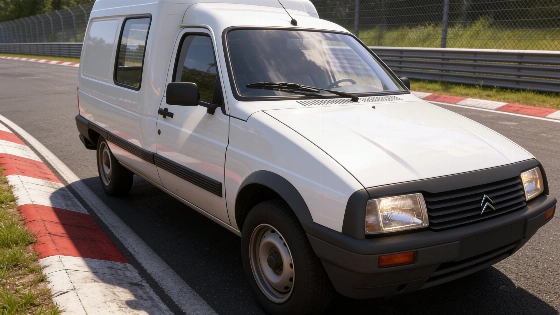
Gerard Casals was 20 when he drove his modified Citroën C15 from a village near Barcelona to the Nürburgring, covering more than 1,200 kilometers before taking the farm van onto the circuit. The Catalan farmer’s son completed a lap of its 170 corners and made the return trip home in one piece. He wasn’t there to chase lap records. He brought a van built for livestock and muddy fields to a track where supercars usually set the tone.
Most drivers at the Nordschleife arrive in performance cars, from Porsches to the latest exotics. BMW M models are common too. Casals arrived in a C15, a van that’s a familiar sight in rural Spain and more used to hauling hay than clipping apexes. His had already survived years of rough roads and heavy loads.
This wasn’t a stock C15. After the original engine gave out at 240,000 kilometers, a bit early for a van known for lasting forever, Casals decided to rebuild. He swapped in a 1.9-liter turbocharged engine from a Citroën Xsara, tuned it to over 100 horsepower, up from the original 69, and stripped out extras like power steering and air conditioning to save weight. He added Koni suspension, trading comfort for control, and set his sights on Germany.
The trip itself was a challenge: more than 1,200 kilometers from a village near Barcelona to the Eifel mountains. The rebuilt C15 handled the lead without trouble. When it arrived, it parked among high-performance cars, its workhorse roots obvious.
On track, the van drew plenty of attention. Spectators and drivers pulled out their phones to record the unlikely sight of a Spanish farm van taking on the Karussell. Even Misha Charoudin, a Nürburgring regular and YouTuber, took it for a lap, making the C15 a minor paddock celebrity for the day.
Casals’s C15 finished the lap and made the return trip home, all in one piece. At a track where performance usually means lap times and brand prestige, the C15 stood out for its reliability and creative engineering, while Casals showed little regard for expectations.
The C15’s change fits into a wider European van culture, where practicality and toughness often matter more than luxury or speed. It also stands apart from recent trends, including Volkswagen’s move toward electrified vans. See the Caddy eHybrid launch. Casals’s project is all about mechanical simplicity and hands-on work.
In a time when technology and status dominate car culture, Casals’s trip is a reminder that resourcefulness and a bit of nerve still count for something. The Citroën C15, once just a rural workhorse, earned a new kind of respect by making it there and back, with a driver willing to try something different.