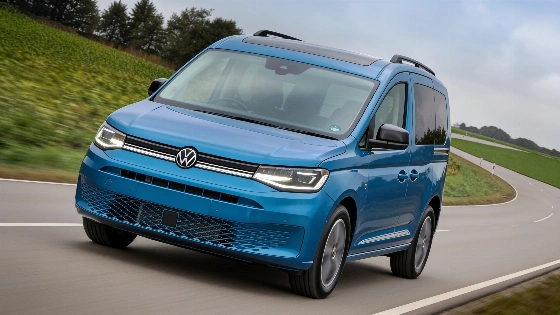
Volkswagen introduces the Caddy eHybrid 2026, a plug-in hybrid van with 150 HP, up to 119 km electric range, rapid charging, and a cavernous boot. Designed for demanding families and professionals, it combines practicality with zero-emission credentials.
Volkswagen has launched the Caddy eHybrid 2026, a plug-in hybrid van that redefines what families and professionals can expect from a multi-purpose vehicle. With a boxy silhouette, sliding side doors, and a focus on interior space, the Caddy eHybrid stands out for its practicality, but now adds a modern edge with sharper lines and vibrant color options.
Measuring 4,500 mm in length, 1,855 mm in width, and 1,798 mm in height, the Caddy eHybrid remains easy to maneuver while maximizing usable space. The 2,755 mm wheelbase ensures a roomy cabin, especially in terms of headroom and accessibility. Inside, the layout is unmistakably Volkswagen: a logical, well-organized dashboard, a responsive 10-inch central touchscreen with wireless Apple CarPlay and Android Auto, and a digital instrument cluster that keeps driving data clear and accessible.
Some controls, like the touch-sensitive light switch borrowed from the VW Golf, may require extra attention, and the interior finish prioritizes durability over luxury. However, the steering wheel retains traditional buttons, and the overall build feels robust. Front seats offer a commanding view and comfort, while rear passengers benefit from generous headroom and adequate leg and shoulder space.
The boot is a highlight, offering 1,213 liters up to the roof with the second row in use—an impressive figure for a 4.5-meter vehicle. The regular shape, vertical tailgate, and sliding doors make loading bulky items straightforward. Importantly, the hybrid system does not compromise the van’s core strengths: the Caddy eHybrid can tow up to 1,500 kg (braked) and carry 665 kg of payload in the tested configuration.
Hybrid Power, Real Electric Range
The Caddy eHybrid’s drivetrain pairs a 1.5 TSI petrol engine (116 HP) with an electric motor of equal output, delivering a combined 150 HP and 350 Nm of torque. The real breakthrough is the 19.7 kWh net battery, which enables up to 119 km of electric-only range—stretching to 147 km in urban conditions. This makes the Caddy eHybrid a genuine daily EV for many users.
Charging flexibility is another strong point: the van supports 11 kW AC charging and up to 40 kW DC fast charging, a rarity among plug-in hybrids. This rapid charging capability significantly enhances its practicality for both city and longer journeys.
On the road, the Caddy eHybrid delivers smooth, predictable performance. The six-speed DSG automatic shifts seamlessly, and the transition between electric and petrol power is barely noticeable. While the 150 HP output is not aimed at thrill-seekers, it provides confident acceleration and overtaking, with measured times of 10.1 seconds from 0 to 100 km/h, 6.6 seconds from 60 to 100 km/h, and 9.2 seconds from 80 to 120 km/h. The top speed is 183 km/h.
Driving Experience and Efficiency
The chassis is more refined than the van’s shape might suggest, absorbing bumps well and keeping body roll in check. The Caddy eHybrid feels stable and secure, with braking distances of 35.6 meters from 100 km/h when cold and 36.3 meters when warm—figures that inspire confidence. Despite its 1,896 kg curb weight, the van maintains a car-like driving feel rather than that of a commercial vehicle.
Efficiency depends heavily on regular charging. With a full battery, consumption hovers around 2.0 l/100 km; once depleted, it rises to 6.4 l/100 km. This means the Caddy eHybrid is best suited for those who can recharge frequently, especially for predictable daily routes and access to low-emission zones. The blue “CERO” label grants unrestricted entry to urban areas, while the petrol engine eliminates range anxiety on longer trips.
Direct competition comes from the Ford Tourneo Connect PHEV, which shares the same technical base, 150 HP, six-speed automatic, 350 Nm, and up to 119 km electric range. Meanwhile, fully electric alternatives like the Peugeot E-Rifter and Citroën ë-Berlingo offer 136 HP and longer WLTP ranges (340 km and 320 km, respectively), while the Renault Grand Kangoo E-Tech reaches 280 km and can be configured with seven seats.
At a price of €44,585, the Caddy eHybrid 2026 is a significant investment. For those who spend most of their time on highways, a diesel TDI version may be more economical. However, the plug-in hybrid’s silent operation, zero-emission badge, and flexibility make it a compelling option for urban families and professionals.
For readers interested in how other brands are shaping the future of electric mobility, the comparison between the Renault 5 E-Tech and Fiat 600e highlights the growing competition in the EV segment, as seen in this recent analysis of urban electric cars.
In summary, the Volkswagen Caddy eHybrid 2026 brings together space, electric range, and charging versatility in a package that meets the evolving needs of Spanish families and professionals. Its combination of practicality and zero-emission capability positions it as a strong contender in a rapidly changing market.