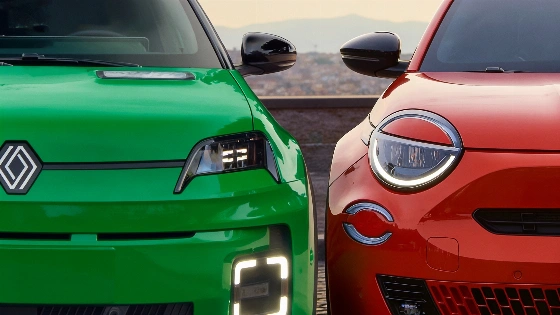
The Renault 5 E-Tech brings retro-inspired style, while the Fiat 600e offers more space and practicality. Both electric models target city drivers, but their strengths and weaknesses set them apart for buyers in Spain.
Renault’s decision to revive the iconic R5 as the all-electric Renault 5 E-Tech has sparked a new rivalry in Spain’s urban EV market. With its unmistakable nod to the classic hatchback, the Renault 5 E-Tech has quickly become a talking point among city drivers, but the Fiat 600e, a larger and more practical crossover, is challenging its appeal with a different set of priorities.
The Renault 5 E-Tech measures 3.92 meters in length, 1.77 meters wide, and 1.50 meters high, with a 2.54-meter wheelbase. Priced from €23,056 including promotions and energy savings incentives, it stands out for its blend of nostalgia and modern tech. The dashboard echoes the original R5, featuring a distinctive H-pattern upholstery and a pair of digital screens—one for instruments (7 or 10 inches, depending on trim) and another 10-inch multimedia display. The system supports wireless Android Auto and Apple CarPlay, and even integrates ChatGPT-powered voice commands under the Reno assistant.
Despite its charm, the Renault 5 E-Tech’s compact size limits rear seat space and boot capacity, offering just 277 liters. Four adults up to 1.80 meters tall can travel comfortably, but practicality is not its strongest suit. Sales figures reflect a solid, if slightly declining, performance: 2,070 units sold so far this year, down 23.25% from the same period in 2025.
Performance and Charging
The Renault 5 E-Tech comes in three power levels. The entry model delivers 95 hp with a 40 kWh battery for 310 km of range, followed by a 120 hp version with similar range. The top variant offers 150 hp and a 52 kWh battery, extending range to 416 km. Charging options vary: all versions support 11 kW AC charging, but only the 120 hp and 150 hp models allow fast DC charging (up to 80 kW and 100 kW, respectively). The base 95 hp model lacks rapid charging, which may limit flexibility for some users.
Fiat 600e: Space and Versatility
The Fiat 600e, at 4.17 meters long, 1.78 meters wide, and 1.52 meters high, is notably larger than its French rival, though its wheelbase is slightly shorter at 2.50 meters. Starting at €27,750 with promotions, the 600e adopts the playful design language of the Fiat 500, but with a more spacious SUV-style body. The boot holds 385 liters—significantly more than the Renault—making it a better fit for families or those needing extra cargo space.
Inside, the Fiat 600e features a 10-inch central touchscreen and a 7-inch digital instrument cluster. While the dashboard can be color-matched to the exterior for a youthful touch, the quality of materials is less impressive than in the Renault. Hard plastics dominate, and some finishes feel basic, but the infotainment system is modern and supports both major smartphone platforms.
Single Powertrain, Flexible Modes
The 600e is offered with a single electric motor producing 156 hp, paired with a 54 kWh battery (50.8 kWh usable) for a WLTP-rated range of up to 409 km. Charging is competitive: 11 kW AC and 100 kW DC, with a 10–80% top-up taking about 30 minutes. Three driving modes—ECO (95 hp), Normal (109 hp), and Sport (156 hp)—let drivers tailor performance to their needs.
Which to Choose?
For city dwellers, both the Renault 5 E-Tech and Fiat 600e offer compelling electric mobility, but their priorities differ. The Renault’s lower entry price is tied to its basic 95 hp version, which lacks fast charging. Upgrading to the 120 hp model with rapid charging raises the price to €26,000, while the 150 hp, 52 kWh variant starts at €28,909—almost €1,200 more than the Fiat 600e, despite offering less space and a smaller boot.
Functionally, the Fiat 600e is the more practical choice, especially for those who value rear seat comfort and luggage capacity. However, the Renault 5 E-Tech’s retro design and advanced tech features may sway buyers seeking style and innovation over outright practicality.
For those considering a broader shift in the automotive landscape, it’s worth noting that other manufacturers are also reimagining classic models for the electric era. For example, Toyota’s plans for a GR Prius, inspired by its Le Mans concept, signal a growing trend of iconic nameplates returning with new technology, as discussed in this recent analysis of Toyota’s hybrid sports ambitions.
Ultimately, the choice between Renault 5 E-Tech and Fiat 600e comes down to personal priorities: style and tech nostalgia versus space and everyday usability. Both models reflect the rapid evolution of the urban EV market in Spain, where design, practicality, and charging flexibility are now central to the buying decision.