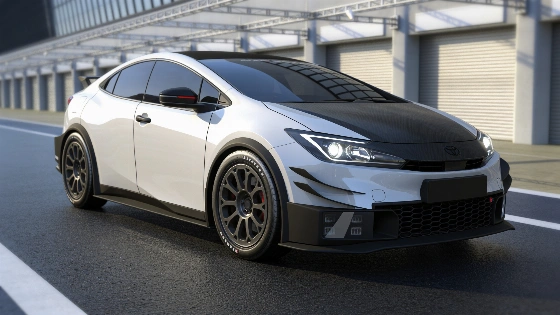
Toyota is reportedly considering a production version of the GR Prius, a sports-oriented evolution of its hybrid pioneer, with a possible debut at the Tokyo Auto Salon in January 2027. If the project moves forward, it could give one of the company’s most recognizable models a radical sports makeover. For now, both the 2027 debut and production plan remain reported possibilities, not announced specifications.
The idea has a clear motorsport precedent. In 2023, Toyota presented the Prius 24h Le Mans Centennial GR Edition as part of celebrations marking 100 years of the 24 Hours of Le Mans. Toyota’s centenary materials linked the project to its wider racing programme, which has also supported work on technologies such as hydrogen combustion. The concept’s widened body and carbon-fiber hood were joined by aerodynamic details and GR010 HYBRID-inspired cues, giving the Prius a distinctly race-focused appearance. Its standard 2.0-liter hybrid powertrain, but, kept the emphasis on design over a major performance increase.
A production GR Prius would raise a different question: how far would Toyota take the engineering beyond the concept’s visual language? The Prius Plug-in Hybrid provides a current performance benchmark. Toyota of Portland’s 2027 model-year overview lists 220 net combined horsepower from a 2.0-liter hybrid system and a 6.6-second 0-60 mph time. For the SE trim, it also gives an EPA-estimated 44 miles of electric range and 129 combined MPGe. The 0-60 mph figure is not the same test measure as 0-100 km/h, so the acceleration claims should not be treated as interchangeable.
A separate 2027 Prius XLE listing from Freeman Toyota identifies a 2.0-liter four-cylinder hybrid engine and an electronically controlled continuously variable transmission. It specifies front-wheel lead. Those details describe a regular Prius listing, not a GR-specific setup. The performance model’s potential hardware so remains the basic question: a GR badge would imply more than sportier bodywork if Toyota intends to position it as a genuine sports hybrid.
Several powertrain routes are being discussed. The most ambitious would pair a three-cylinder turbo engine with all-wheel lead, following the broad formula used by the GR Yaris and GR Corolla. Output could exceed 300 hp. Another proposal would retain the 2.0-liter engine and add a more powerful electric system, possibly with E-Four all-wheel lead. A further scenario draws on the reported 324-hp RAV4 GR Sport PHEV setup. In a lighter Prius, that plug-in hybrid arrangement could target acceleration below five seconds to 100 km/h. These remain proposed directions, not published GR Prius specifications.
The prospect of a high-performance Prius fits a wider shift: established models are being reworked for audiences seeking both efficiency and driving engagement. Toyota’s Gazoo Racing identity gives the company a structure to explore that territory, while the 2023 Le Mans-centenary Prius showed how motorsport styling could reshape the model’s image. Toyota is not alone in prompting debate about the balance between electric mobility and traditional performance, as a recent feature highlights.
The Tokyo Auto Salon has long provided a stage for performance concepts and bold model interpretations, making a GR Prius reveal there a natural fit. Whether Toyota takes the idea from concept to production will depend on how it balances output with all-wheel-lead capability and the efficiency that defines the Prius. If a 2027 debut happens, that balance will sit at the center of the car’s appeal.