Turkish plants account for 65.5% of the value of buses the EU imports from outside the bloc, according to figures presented during a visit to Anadolu Isuzu. That gives Turkey a concrete argument as Brussels debates whether its factories should count under «Made in Europe» rules. The EU-Türkiye customs union, established for industrial products under Decision No. 1/95, provides a framework for free circulation; implementation rules use an A.TR movement certificate to confirm that status. It does not in itself determine whether a vehicle qualifies as «Made in Europe» under a future industrial-policy rule.
The country wants to remain inside the framework, pointing to the role its factories play in European supply chains. MAN says every job at its Ankara plant is linked to 2.5 jobs in the EU through suppliers and other industrial activity involved in making its buses. The company argues that vehicles assembled in Turkey incorporate European components and systems, alongside technology and expertise. An EU-commissioned assessment by ICF International described Turkey’s automotive sector as having attracted manufacturers including Toyota, Ford, Hyundai, MAN, Renault, Fiat, Mercedes-Benz and Isuzu.
The link runs both ways. Denso España supplies the engine control unit for cars built at Toyota's Turkish factory, according to information presented during the visit. Turkey's automotive exporters also cited investments by European suppliers, including Gestamp and Antolin. The question of where European vehicles are built also reaches Spain: a report on Volkswagen's Spanish factory plans described shared electric-car production at Martorell and Landaben.
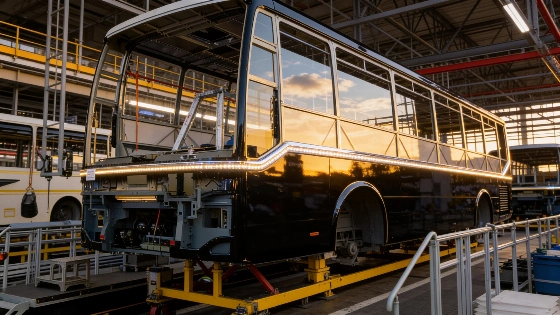
Production methods vary sharply across Turkey's automotive plants. On the Mercedes-Benz bus line visited by Economía Digital, workers carried out assembly with hand tools; no robots were visible along the route. The low production volume helps explain the labour-intensive process: MAN makes 18 buses a day in Ankara, with a maximum annual capacity of 4,100 vehicles.
That capacity requires 4,721 workers, including external staff, and the factory operates two shifts. Toyota's Turkish plant has 4,500 direct employees and runs three shifts, with capacity for 280,000 cars a year. It builds the C-HR, a hybrid that is among Spain's leading sellers in its category. The comparison shows the difference in scale, although the factories make different types of vehicles.
Automation is far more visible at Toyota. During the visit, an autonomous platform stopped when its sensors detected a trolley blocking the route; nearby robots moved parts as the car assembly cycle continued. The contrast reflects the much higher output possible in car production, while bus assembly remains more dependent on manual work.
Turkey's bus plants already serve European demand at scale. The Mercedes-Benz facility in Hoşdere is Daimler Buses' largest plant for complete buses. It produced 4,462 buses in 2025 and exported 3,832; Europe received 95% of those exports. Eurostat recorded a Turkish stock of 753,594 buses, motor coaches and trolleybuses in 2025; that figure counts vehicles in the fleet, not factory output or exports.
Capacity constraints have also led Mercedes-Benz to agree that another Turkish manufacturer, Otokar, will produce its Conecto city bus. Mercedes-Benz says the work is labour-intensive and points to workers' skills and commitment as advantages of production in Turkey. Its operations in the country began in 1967, and investment since then totals €4.5 billion at current value.
OICA figures supplied by OIB rank Turkey fourth among global bus manufacturers in 2025. In the other categories, it ranked ninth in light commercial vehicles and fourteenth in passenger cars. MAN supports the EU's aim of protecting industry from China, while arguing that rules should reflect how industrial vehicles are made and how their supply chains cross borders. The European Environment Agency says EU rules require 90% of new city buses to be zero-emission by 2030 and 100% by 2035. Eurostat recorded 591 zero-emission buses, motor coaches and trolleybuses in Turkey in 2025.