Researchers have detected erythrulose in a Milky Way molecular cloud. The result shows that space can supply carbohydrates for chemical reactions linked to the origins of life.
G+0.693−0.027 sits about 26,700 light-years from Earth, near the centre of the Milky Way. Researchers have now detected erythrulose inside it, marking the first reported identification of this four-carbon sugar in interstellar space.
The finding does not show that life began in space. It does show that a molecule linked to the possible prebiotic synthesis of nucleic acids can exist where stars and planets form.
The identification was based on 12 spectral lines of erythrulose matched against laboratory measurements, providing a detailed spectroscopic confirmation rather than a single ambiguous signal.
The work came from researchers at the Centro de Astrobiología (CSIC-INTA) in Madrid and Shaoshan Zeng of the Laboratory of Star and Planet Formation in Wako, Japan. Their paper, Detection of a chiral four-carbon sugar in interstellar space, appeared in Nature Astronomy on July 13, 2026. Its DOI is 10.1038/s41550-026-02905-7.
Izaskun Jiménez-Serra led the team. The same researchers studied this cloud in 2023 and found two amides, acetamide and trans-N-methylformamide. That work appeared in Monthly Notices of the Royal Astronomical Society.
G+0.693−0.027 is cold, dusty and close to the Milky Way's centre. Gas and dust gather in such clouds before new stars and planetary systems emerge.
Space leaves clues.
Astronomers had already found many organic molecules in this cloud. One was glycolaldehyde, a compound involved in sugar formation. CSIC said the new result supports the use of these clouds as records of complex chemistry that existed before the Solar System formed.
The researchers did not collect a physical sample. They used radio astronomy instead.
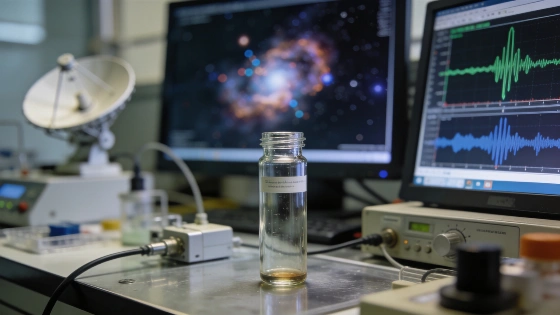
Observations came from the Yebes 40 m and IRAM 30 m radio telescopes. The team compared the radio emissions from the cloud with the characteristic spectra of different molecules. Each compound produces its own radio signature.
The analysis needed computational chemistry, laboratory measurements and simulations. It was not a simple visual match.
In the same region, the erythrulose signal was reported to be at least eight times more abundant than signals from comparable three-carbon sugars. The comparison adds a quantitative measure to the significance of the first interstellar sugar detection.
Searches for simpler sugars with two or three carbon atoms produced no result. The researchers then tested longer carbon chains.
The erythrulose signal matched the expected spectrum across the observed transitions. That match produced the first reported identification of the sugar in interstellar space.
The molecule may have formed before the Solar System existed. Chemical modelling discussed with the observations suggests that interstellar ices could produce erythrulose from simpler precursors.
Comets and asteroids could have trapped the compound and later carried it to Earth. The researchers also link that possibility to the Late Heavy Bombardment, or lunar cataclysm, a hypothetical event dated to between 4.1 and 3.8 billion years ago.
Their estimate puts the possible delivery at between half a million and 50 million tonnes of erythrulose during that period.
That estimate depends on a hypothetical event. It does not show that erythrulose caused life to appear.
The point is narrower. The interstellar medium now looks like a chemically plausible source of carbohydrates for prebiotic reactions on the early Earth and potentially elsewhere in the universe.
Erythrulose has a familiar use on Earth. Some self-tanning cosmetics contain it, usually alongside dihydroxyacetone. The compounds react with proteins in the outer layers of the skin.
The effect resembles the Maillard reaction. That group of chemical reactions creates the browned colour and characteristic aroma of many cooked foods.
Erythrulose is authorised for cosmetic use in Europe but not in the United States. It also occurs naturally in small quantities in fruits such as raspberries.
The discovery adds one specific molecule to the growing inventory of organic compounds found beyond Earth. It gives researchers another reason to study molecular clouds as chemical records from before the Solar System.
Erythrulose is not evidence of life itself. It is evidence that one possible ingredient for life's early chemistry can form in space. The distinction keeps the claim modest, while the chemistry remains significant.