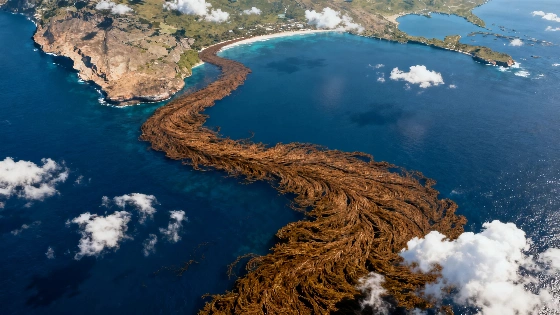
A vast brown ribbon of sargassum stretching across the Atlantic has reached record size, raising urgent questions for scientists. The explosive growth, now visible from space, is reshaping coastlines and ecosystems from Africa to the Gulf of Mexico.
In 2025, satellites captured a striking image over the Atlantic: a sprawling brown band of sargassum algae, stretching an astonishing 8,800 kilometers from the coast of West Africa to the Gulf of Mexico. This phenomenon, now known as the Great Atlantic Sargassum Belt, has rapidly transformed from a rare curiosity into a major environmental signal, according to research published in Harmful Algae.
Just fifteen years ago, such a massive accumulation was unheard of. By May 2025, scientists detected 37.5 million tons of sargassum floating in the Atlantic—a scale that dwarfs previous records and now exceeds twice the width of the continental United States. The sudden surge has left researchers racing to understand what is fueling this explosive growth and what it means for the ocean and coastal communities.
From Anomaly to Annual Crisis
Teams at the Harbor Branch Oceanographic Institute, part of Florida Atlantic University, have pieced together four decades of satellite data, field observations, and chemical analyses to track the sargassum’s rise. The first major bloom was recorded in 2011. Since then, the phenomenon has recurred almost every year, with only a single exception in 2013. What was once a rare event has become a near-annual challenge, reshaping the Atlantic’s ecological balance.
Sargassum: Essential Habitat or Coastal Threat?
Sargassum pelagicum, the species behind the belt, is not inherently harmful. Floating freely in the open ocean, it provides vital habitat, food, and breeding grounds for over 100 marine species, including fish, invertebrates, and sea turtles—a fact recognized by the US National Oceanic and Atmospheric Administration (NOAA). In moderation, sargassum supports ocean life. The problem arises when its biomass explodes, forming dense mats that drift ashore in overwhelming quantities.
When these masses reach the coast, they quickly become a nuisance. As sargassum decomposes, it releases foul odors and hydrogen sulfide, a toxic gas linked to the decay of organic matter. The result: beaches blanketed in rotting algae, disrupted coastal ecosystems, and a direct blow to tourism-dependent economies, which must invest heavily in constant cleanup efforts.
Nutrient Overload: The Engine of Growth
Researchers have pinpointed excess nutrients—especially nitrogen and phosphorus—as the main drivers behind the sargassum boom. Experiments show that in nutrient-rich waters, sargassum biomass can double in just 11 days. Between 1980 and 2020, nitrogen content in sargassum tissues rose by 55%, while the nitrogen-to-phosphorus ratio increased by 50%. This chemical shift reflects a profound change in the Atlantic’s nutrient dynamics, fueled by agricultural runoff, wastewater discharges, and atmospheric deposits.
Much of this nutrient influx originates on land. Agricultural fertilizers and waste are washed into rivers, then carried to the ocean, where they feed the sargassum. The process, known as eutrophication, is no longer confined to coastal zones—it is now reshaping vast stretches of the open sea.
The Role of Rivers and Ocean Currents
The Amazon River stands out as a key player in this unfolding story. During flood seasons, it releases huge amounts of nutrients into the Atlantic, fueling sargassum growth. In drier periods, the blooms subside. Ocean currents, including the Loop Current and the Gulf Stream, act as natural conveyors, transporting sargassum across the ocean and into sensitive regions like the Gulf of Mexico. There, large sargassum accumulations have been documented since at least 2004, sometimes even forcing the shutdown of critical infrastructure, such as a nuclear power plant in Florida in 1991.
Risks for Beaches, Ecosystems, and Tourism
When sargassum washes ashore in massive quantities, the consequences are immediate and costly. Decomposing algae can suffocate beaches, lower oxygen levels in coastal waters, and damage coral reefs. For communities reliant on tourism, the economic impact is direct: unsightly, foul-smelling beaches deter visitors, while cleanup operations demand significant resources.
What Can Be Done?
The study’s authors call for stronger international monitoring, improved predictive models, and a sustained reduction in nutrient pollution. Practical steps for vulnerable coastal areas include enhanced satellite tracking of sargassum belts, better forecasting of landfall events, tighter controls on nitrogen and phosphorus runoff, and rapid deployment of cleanup teams when large accumulations are detected offshore.
While these measures cannot eliminate the phenomenon, they can help communities respond more quickly and limit the damage. The scale and frequency of sargassum blooms since 2011 suggest that the Atlantic is undergoing a fundamental shift—one that demands coordinated action and long-term vigilance.
Climate Questions and the Carbon Cycle
The implications of the Great Atlantic Sargassum Belt extend beyond beaches and tourism. As sargassum decomposes, it releases methane and other greenhouse gases, raising new questions about its role in the global carbon cycle. With warming seas and a steady flow of nutrients from land, scientists warn that the Atlantic’s transformation is far from over. The 8,800-kilometer brown belt, now visible from space, stands as a stark indicator of how human activity is reshaping the world’s oceans.