Personal letters and memoirs from Alfons de Batlle, a frontline medic, expose the harsh realities and moral dilemmas faced by ordinary Spaniards during the Civil War. His story, preserved by family, challenges official narratives and reveals the private cost of conflict.
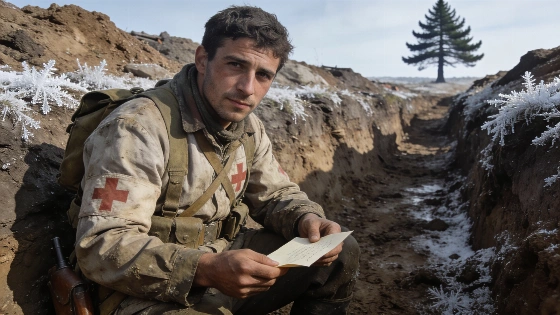
On the frozen front lines near Teruel, a single order nearly cost a young soldier his life—not from enemy fire, but from his own commander. Alfons de Batlle, serving as a medic in the Republican army, watched as another conscript was sentenced to death for dropping his weapon during a bombardment. The execution was called off at the last minute and replaced with a public hanging. This was not a one-off act of cruelty, but a warning: weapons could not be left behind, even as bombs fell.
De Batlle described these moments in his postwar memoirs and in dozens of letters sent to his fiancée, Maria Tuèbols. Preserved by his daughter Josefina and studied by historian Xavier Martí i Ylla, these writings form the core of the book "Alfons de Batlle, Mestre empordanès" (Norfeu). The letters, written in Catalan between August 1937 and November 1938, avoid propaganda and heroics. Instead, they record the daily struggle to survive—sometimes by taking a prisoner’s shoes, sometimes by trading for tobacco made from potato leaves.
The use of personal letters as primary sources for reconstructing wartime experience is a recognized method in European historiography, as seen in the French collection 'Paroles de poilus'.
De Batlle’s story is not about strategy or politics. He grew up in Llers, in a well-off farming family, mostly raised by his grandfather. After the war, he became a teacher, married Maria, and started work in Espolla in 1940. Despite the Franco regime’s suspicion of teachers, de Batlle returned to the classroom, likely thanks to his family’s local reputation. His teaching, shaped by Republican ideals, quietly contrasted with the official doctrine of the new regime.
His letters show a man more worried about his loved ones than about ideology. He feared for Maria’s safety during the bombings of Figueres and for his own in the freezing trenches of Aragón. Supplies were so scarce that he wore the same shirt for five months. In one strange episode, soldiers from both sides, separated by only a few meters, agreed to play football. De Batlle played barefoot, afraid that scoring might set off gunfire. The match ended without violence, but days later, the same men were fighting again.
De Batlle’s postwar writing is blunt in its criticism of military and political leaders. He describes commanders giving patriotic speeches from armored cars and politicians making propaganda visits far from the wounded. Even Líster reviewed the troops from a fortified train car. The gap between those giving orders and those suffering the consequences runs through his account.
According to recent research, the battle for Teruel remains one of the most studied episodes of the Spanish Civil War, but much of the available public material focuses on modern political events in the city rather than detailed military history. For a comprehensive understanding of the conflict, historians recommend consulting specialized archives and museum collections dedicated to the war period.
Family betrayal haunted de Batlle as much as the war. An inheritance dispute led an uncle to shoot at him, and a priest—his legal guardian—embezzled his assets. Despite this, de Batlle saved the lives of two priests during the conflict, only to be refused help by them later when he needed it.
For de Batlle, writing was a way to endure. His letters to Maria, now the only surviving side of their exchange, show the need for human connection in chaos. They also challenge official histories, focusing on the lives of ordinary people rather than the words of leaders. Because his family kept these documents, historians can now piece together a more detailed picture of the war’s effect on individuals.
The Spanish Civil War has been covered in countless official accounts, but for people like de Batlle, the reality was more complicated and personal. His story, told in his own words, shows the gap between propaganda and lived experience. That these letters survived at all is remarkable, given the regime’s efforts to control the story. As seen in other recent cases, such as the reported earlier judicial scrutiny of official actions, Spain’s history is often shaped as much by what is hidden as by what is declared. De Batlle’s legacy is not just a record of suffering, but a reminder that the real cost of war is measured in private losses and the quiet endurance of those who refuse to forget.