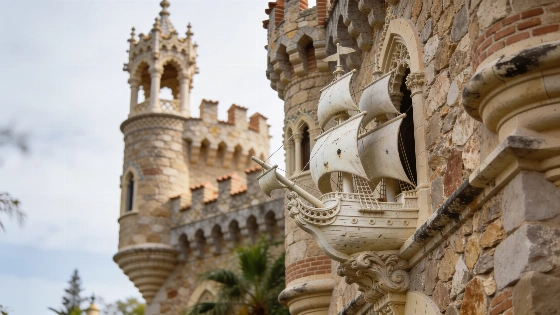
Colomares Castle in Benalmádena was built between 1987 and 1994 by a doctor and two masons. Its tiny chapel and Columbus-inspired details make it an unusual monument to the 1492 voyage.
The chapel at Colomares Castle covers just 1.96 square metres. Dedicated to Santa Isabel de Hungría, it is listed in Libro Guinness de los Récords and contains images moulded by the monument’s creator, Esteban Martín Martín.
The site in Benalmádena honours Christopher Columbus and the 1492 voyage, yet looks centuries older than it is. Construction began in 1987 and ended in 1994. Martín and two masons carried out the work over seven years. It is a modern monument, not a surviving medieval castle.
Martín was a doctor born in Granollers in 1926. After working in the United States, he returned to Spain and launched the project on a property he owned. The builders worked by hand, using handmade brick and stone, with cement in the construction.
Colomares turns Columbus’s first voyage into architectural detail. La Niña stands at the highest point beneath an arch associated with La Rábida. La Pinta appears on the main façade. La Santa María is set apart to recall its shipwreck on Christmas Eve in 1492.
Bronze shields represent Castile and Queen Isabella. A small oratory called the Oratorio del Salvador has a maritime bell recalling the island of San Salvador. The towers and arches draw on Gothic and Romanesque styles, alongside Byzantine and Mudéjar influences. The design also pays tribute to the three religions present in Spain in 1492.
A bronze horse’s head represents Martín Alonso Pinzón, the navigator from Palos de la Frontera in Huelva. In the monument’s story, Pinzón helped persuade experienced local sailors to join Columbus. Conceived as Pegaso, the mythical horse, the figure symbolically supports La Pinta, the ship associated with the Pinzón brothers.
The grounds also contain a Gothic-inspired mausoleum with a large rose window. It represents Columbus’s fifth and final journey as a spiritual passage towards eternity, but was never used as his tomb. The distinction matters among Spain’s varied sites of historical memory: an earlier report covered a Franco-era grave excavation in Cáceres where six bodies were found.
Colomares stands in the La Carraca area beside the Costa del Sol road, around five minutes from Benalmádena’s old town and about 20 kilometres from Málaga. The listed schedule says it is closed on Mondays. From Tuesday to Sunday, opening hours are 10:00 to 18:00 in autumn and winter, 10:00 to 14:00 and 17:00 to 21:00 in summer, and 10:00 to 20:00 in spring.
Groups of 25 or more can book a reduced rate and a guided talk in advance. Visitors are advised to arrive early for a quieter walk through the grounds.