Six bodies have been found in an excavation at Cáceres cemetery, with skull injuries compatible with gunshot trauma. The work is funded by the provincial government and Spain’s basic government.
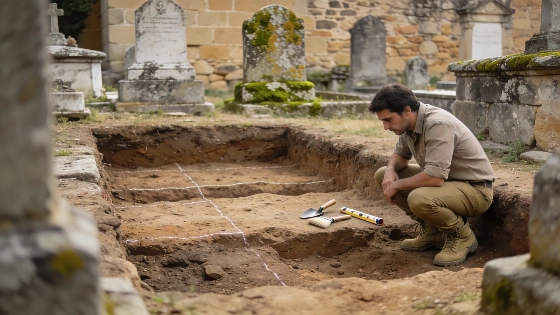
Excavation in Cuartel 4, known as the old Limbo, at Nuestra Señora de la Montaña Cemetery began on 5 October 2026; the first remains were found on the afternoon of 19 October. Six bodies have been located so far, with injuries sustained around the time of death that are consistent with violence. This is an early stage in an ongoing exhumation and forensic-anthropological study of victims of the Civil War and Francoist repression.
Some skull injuries are compatible with trauma from firearm projectiles. The findings do not yet identify the victims or establish the circumstances of each death. Aranzadi’s forensic anthropologist and project director, María Fortuna Murillo, is leading the investigation.
Historical records place 153 victims of Francoist repression in this section of the cemetery, including five women. The forensic team is documenting the arrangement of the graves. Available information suggests the plot may contain at least eight rows, with between one and four graves in each. The wider cemetery area may contain close to 300 victims. Cuartel 4 lies in a historically peripheral part of the site, associated with unconsecrated ground before it became part of the cemetery.
The technical team has records of victims’ dates and ages at death. Researchers will compare those details with anthropological examination of the recovered remains to develop identification proposals. Scientific procedures may include genetic analysis where appropriate.
The project is funded by the Diputación Provincial de Cáceres and Spain’s Secretary of State for Democratic Memory. The Asociación Memorial en el Cementerio de Cáceres (AMECECA) and the Sociedad de Ciencias Aranzadi are carrying out and coordinating the work. Project director María Fortuna Murillo, a forensic anthropologist with Aranzadi, is leading the investigation. Researchers are documenting the layout and sequence of the graves as excavation continues.
During a visit to the cemetery on 23 October, provincial president Miguel Ángel Morales said the institution would support efforts to recover and identify the remains. He also backed their later burial in dignified graves, saying the work should help families learn where their relatives are buried. The Diputación has taken part in similar work before, including an intervention at the Terría mine in Valencia de Alcántara.
Morales said the work should help families learn where their relatives are buried and bring a period of suffering to a close. He also argued that public institutions should support families through the process. The family dimension has appeared in other historical reporting: an RTVE documentary report gave relatives of two murdered police officers their first televised testimony.
Excavation and exhumation in Cuartel 4 are set to continue through the rest of 2026. Laboratory studies of recovered remains are due to begin early next year, alongside excavation in Cuartel 1, where victims of repression are also documented. Identification proposals will draw on anthropological findings and historical records, with genetic analysis where appropriate. AMECECA is keeping families informed, while relatives continue to visit the cemetery to follow the work.