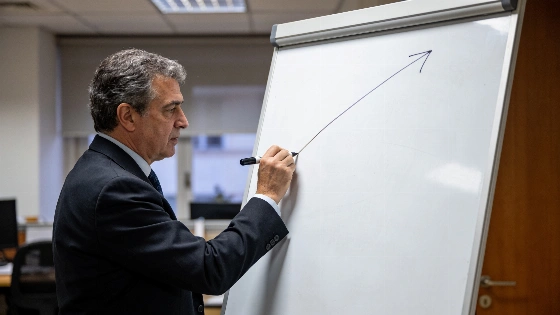
At a whiteboard in his office, Alberto Nadal sketched why he believes economic growth is failing to reach at least 60% of households: he blames the government’s tax policy. The co-author of the PP’s economic programme with Juan Bravo said in his first interview since its publication, given to EL MUNDO, that the party’s promises depend on the public accounts Pedro Sánchez leaves behind. In the PP’s economic-policy messaging, Nadal, the party’s deputy secretary for Economy and Sustainable Development, has also linked weak investment to productivity and wage growth.
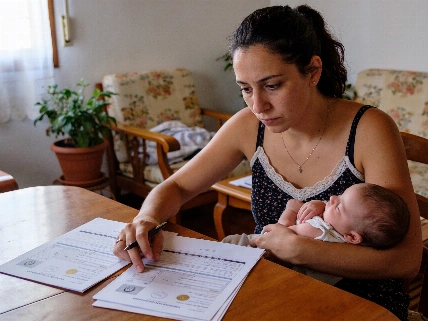
For workers with children, Nadal says the programme would double deductions in Spain’s personal income tax, known as IRPF. A PP government would also keep VAT on basic food at zero while the current inflation situation continues. Families would feel the tax reduction in their payslips under the party’s first budget, he says, if it takes office. The PP programme also proposes updating family tax allowances with inflation and replacing them with a single family deduction that is refundable and paid monthly, including for households with too little IRPF liability to use a conventional deduction.
An earlier RUSSPAIN report covered a proposed measure for 760,000 families; Nadal’s plan here instead focuses on tax deductions, as this family-policy report describes.
The interview does not fully cost the tax plans. Nadal says the PP must first establish the state of the public finances, and argues that Sánchez could leave hidden deficits. He also says Spain might have to repay European funds, depending on the EU’s assessment of how they were spent.
That uncertainty shapes the party’s proposed spending path. Nadal says an independent audit would examine public expenditure and the management of state-owned companies, including their contracts. Any irregularities would be reported, he says. Spending judged unproductive would be cut. The PP programme says a future government would audit administrative spending during its first 100 days and retain no expenditure simply because it had existed before.
He argues that Spain’s public debt is higher than it should be, citing an additional €500 billion accumulated and saying the country has not substantially reduced debt relative to GDP after the euro crisis reforms. Nadal considers extraordinary measures like those taken in 2011 less likely. Still, he says a future PP government would have to discuss its debt-reduction target and spending plans with Brussels under the new European fiscal rules.
His proposed room for tax cuts would come partly from reprioritising expenditure. Nadal says most public-spending lines have grown faster than the economy since 2018. He argues that slower spending growth could make room for tax reductions while protecting essential services and pensions. He also considers infrastructure to be in critical condition and says it would be a priority. In remarks at CEU Cardenal Herrera University in Valencia on 11 November 2026, he connected investment needs to infrastructure maintenance and housing shortages, and discussed electricity networks. He also pointed to the adoption of new technologies and training. He has identified railways and roads, as well as water systems, as areas requiring renewed investment.
Nadal also disputes the government’s claim that pensioners have retained their purchasing power. He argues that unadjusted income-tax thresholds can increase the tax burden as inflation pushes up wages or pensions. The PP would update IRPF parameters to prevent that effect, he says. The party has separately pledged to deflate IRPF brackets, a measure aimed at stopping inflation-driven nominal income increases from pushing taxpayers into higher tax burdens.
If the PP wins power, Nadal says it intends to present a budget for 2027 in the spring of that year, followed by a 2028 budget no later than 30 September 2027.