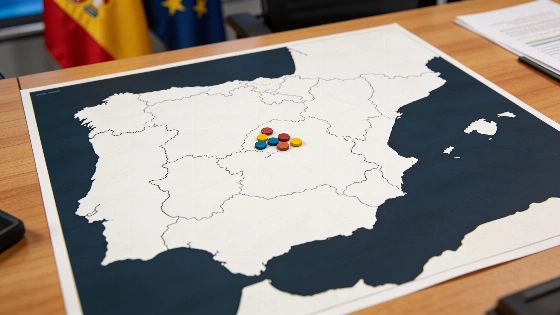
In Lleida, five parties are competing for the province’s final two seats, according to a forecast based on polls published through 9 November. Junts and PP are among the contenders. PSOE, ERC and Vox are also fighting for those places in a constituency that elects four MPs. Spain’s 350-member Congress is elected through 52 constituencies: the 50 provinces, plus Ceuta and Melilla. Each province receives at least two seats, while Ceuta and Melilla receive one apiece.
That local contest falls within a national estimate that classifies 153 seats as safe and 150 as probable, with 97 in play. The categories add up to more than 350 because several parties can compete for the same seat. Madrid has ten seats in play and Barcelona has nine, the largest totals among the provinces. Seats are allocated separately in each constituency, not from a single nationwide pool. After the provincial and city minimums, the remaining 248 seats are distributed among provinces according to population.
EL PAÍS says its model runs 20,000 election simulations, assigning each seat according to how often a party wins it. A seat is safe when a party takes it in more than 99% of runs; it is probable at 75% to 99%, and in play at 25% to 75%. For the actual allocation, lists must first reach 3% of valid votes in the relevant province to qualify. Seats then go to eligible lists using the D’Hondt method, which ranks their vote totals after division by successive integers starting at 1.
The estimates start with a polling average weighted by survey size, date and each pollster’s historical accuracy. A statistical model then projects the vote by province, drawing on the 2023 general election. For new parties or those now running separately, it also uses results from the 2024 European election and the 2026 Andalusian election. The model includes CIS survey microdata from each autonomous community.
Provincial estimates carry extra uncertainty. EL PAÍS says national polls with 2,000 or 5,000 interviews cannot directly measure support in places such as Soria, Pontevedra or Castellón. The model combines provincial voting history with regional CIS data, then adjusts uncertainty using errors recorded in 44 Spanish elections since 1986 and an international database of thousands of polls.
Local parties and smaller lists can still shift individual results. Teruel Existe wins a seat in one in five simulations. In Madrid, Podemos takes a seat in 60% of runs, while SALF does so in 24%. The model uses t-distributions to allow for wider polling errors than a normal distribution. One component is shared across Spain; another is specific to each province.
The model’s past performance offers a check on those probability bands. All 189 seats classified as safe before the 2023 general election were won. The safe seats forecast for the two 2019 elections were also won: 156 and 153. Probable seats came through 365 times out of 388, or 94%.
Across general elections from 2016 to 2023, the seat totals for the major parties fell within the model’s 80% range in 19 of 20 cases. Readers following the campaign alongside the projections can also find RUSSPAIN.COM’s report on Colau’s scheduled interview on La Revuelta.