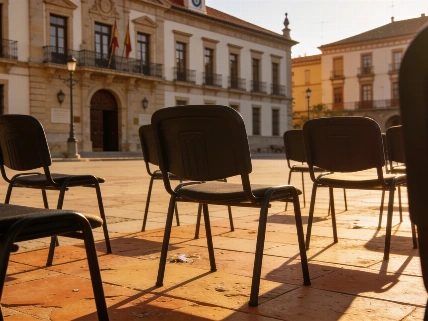
About 200 people gathered in Salamanca’s Plaza de los Bandos to protest Santiago Abascal’s visit, according to police sources. At the Vox election event, Abascal used the dispute over post-election alliances to press Alberto Núñez Feijóo for a clear position before the 29 November vote. The snap election followed Prime Minister Pedro Sánchez’s dissolution of Parliament.
Abascal welcomed Feijóo’s decision not to offer Pedro Sánchez an agreement during their face-to-face debate. The televised encounter took place on 19 November, ten days before the election. It covered the economy and housing, as well as immigration and corruption. Foreign policy and women’s policies also featured. Abascal said the PP leader should state whether he would make a deal with what he called the remnants of the PSOE or had another plan. The debate itself produced no commitment from Feijóo on future alliances.
The election’s government-formation arithmetic has centred on the PP and Vox. A POLITICO/PF Global poll published on 19 November put the PP at 29.5% of intended votes. The PSOE stood at 27.2%, while Vox had 19.6%. Polling cited by several outlets projected the two right-wing parties together at as many as about 190 seats in the 350-member Congress. The PP already governed in coalition or cooperation with Vox in four regions. Feijóo has said any agreement must respect constitutional limits and European treaties.
Abascal pointed to Ceuta as evidence of what he sees as a contradiction in the PP’s approach. He said Vox had spent 100 days offering to form a joint government with the PP there, while the popular party maintained its agreement with the PSOE and Islamist parties. That was Abascal’s account of the negotiations.
The Ceuta dispute also recalls earlier coverage of Ceuta, which concerned a separate PSOE disciplinary decision involving deputy Melchor León.
Abascal also attacked Sánchez’s assessment of the debate. After the encounter, the prime minister went to the PSOE headquarters in Ferraz and described it as good politics paired with bad manners, with party members present. Abascal called the gathering orchestrated and accused Sánchez of sending hired enforcers after a judge investigating his brother. The material provided did not independently establish the accusation.
On immigration, Abascal rejected the idea that Vox and the PP shared the same underlying position. He said the PP was moving towards some Vox proposals for electoral reasons. Vox, he said, prioritised Spaniards and legally arrived immigrants who work and respect Spanish laws and way of life. He also said Spain should admit no more people at present.
Abascal’s appeal to Catalan voters included a rejection of any approach to Carles Puigdemont, after the former Catalan president warned Vox would be turned away. Abascal said Vox would not seek anything from Puigdemont, but would still ask Catalans for their votes.
Abascal defended the party’s campaign gestures, including ending a Girona rally with “¡Visca Catalunya!” followed by “¡Viva España!” He maintained Vox’s opposition to the autonomous-community system. Constitutional reform, he said, would require reinforced majorities beyond the reach of the next legislature. He argued that the party could defend Catalan identity as part of Spanish identity.
The same theme surfaced at a Vox rally in Badalona, where housing spokesman Carlos Hernández Quero defended recognition of cultural and territorial identities. His remarks followed criticism from Cayetana Álvarez de Toledo, the PP’s number two candidate in Madrid. She accused Abascal of adopting part of Catalan nationalist discourse.
Aliança Catalana, led by Sílvia Orriols, is outside the election race. The source says other right-wing parties in Catalonia are therefore competing for voters who would otherwise have had that party as a reference.