Two women were arrested in Mallorca for vandalizing real estate offices. The case has fueled debate over police response to anti-tourism activism. Authorities link the acts to a protest movement against tourist overcrowding.
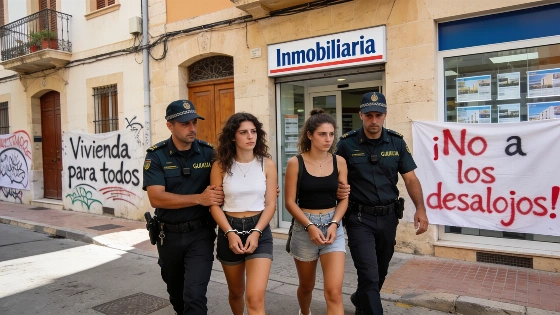
Controversy has erupted in the Balearic Islands after two 28-year-old women were arrested in Santa Maria del Camí, Mallorca, accused of coordinated vandalism targeting five local real estate agencies. The arrests, carried out by the Guardia Civil just days before a large demonstration against tourist overcrowding in Palma, have intensified debate over the authorities’ handling of anti-tourism activism.
According to the official report accessed by EL PAÍS, the women are suspected of spray-painting slogans such as “Fuera guiris” and “A casa” on the shopfronts and sealing locks with glue during the night of May 31. The Guardia Civil alleges that the actions were premeditated and followed instructions from a manual circulated by groups opposing mass tourism, which encouraged non-violent direct action against tourism-related businesses. The manual, published on social media by the Menys Turisme Més Vida platform on July 7, reportedly advised activists to cover their faces, use spray paint, and block locks—methods mirrored in the incidents under investigation.
After reviewing security camera footage, investigators identified the two women, one of whom had a banner reading “Sos residents, stop overturisme” displayed on her balcony. The Guardia Civil cited this as further evidence of her involvement. Both detainees, represented by lawyer Josep de Luis, exercised their right not to testify before police or the judge. They were released on provisional liberty after appearing in court.
The arrests have drawn sharp criticism from local social, union, and environmental groups, who argue that the police response is disproportionate and part of a broader campaign to criminalize protest against tourism saturation. The Menys Turisme Més Vida platform, which includes around 60 organizations, is organizing a major demonstration in Palma on July 26. Political figures have also intervened: Vicenç Vidal, a deputy from Més per Mallorca, has called for the Minister of the Interior and the Secretary of State for Tourism to explain the police operation in Congress, describing the situation as extremely serious and warning against any infringement of fundamental rights.
Balearic Vice President Maria Antònia Estarellas declined to comment on whether the arrests were excessive but emphasized the importance of peaceful demonstrations and respect for public property. The GOB, the islands’ main environmental group, echoed concerns that the detentions are intended to intimidate those planning to join the upcoming protest. The Association of Agrarian and Ecological Production of Mallorca also questioned the scale of the judicial response, expressing concern that such police actions could be seen as a warning to those debating Mallorca’s future.
This incident comes amid heightened scrutiny of law enforcement and political accountability in Spain. In a related context, recent calls for Interior Minister Fernando Grande-Marlaska to clarify the role of the Guardia Civil in politically sensitive operations have been reported, as seen in recent parliamentary inquiries into police conduct. The debate in Mallorca reflects broader national tensions over protest rights, public order, and the impact of tourism on local communities.
Tourism remains a cornerstone of the Balearic economy, accounting for a significant share of regional GDP and employment. However, the rapid growth in visitor numbers has fueled concerns over housing affordability, environmental degradation, and the erosion of local identity. In recent years, grassroots movements have gained momentum, demanding stricter regulation of holiday rentals and greater protection for residents. The current wave of protests and the authorities’ response highlight the ongoing struggle to balance economic interests with social and environmental sustainability in one of Spain’s most visited regions.