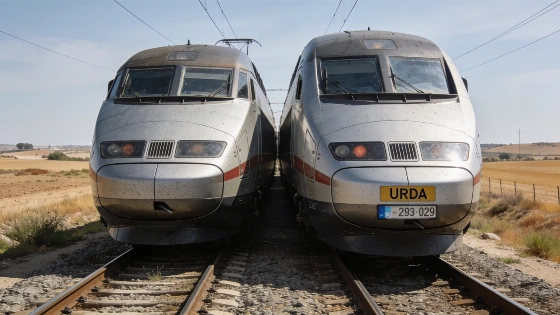
At 8:48, the Iryo driver told Atocha she was still stopped at Urda’s entry signal because she could not check the LZB system. Six minutes later, at 8:54, a Renfe AVE struck the rear of the Iryo on the same track near Urda, in Toledo province, on the Madrid-Seville high-speed line. The crash occurred about 140 kilometres south of Madrid.
Audio recordings obtained by elDiario.es show that control cleared the AVE to resume normal running even though the Iryo was ahead of it. The impact derailed two carriages of the AVE, information from Deutsche Welle. By late Wednesday, authorities had reported at least 68 deaths and more than 100 people injured, many of them seriously. Reuters reported approximately 58 injured in its account of the developing casualty toll.
The sequence began around 8:30, according to the Transport Ministry’s preliminary explanation. A failure in the LZB train-control system automatically stopped six trains. Adif’s 24-hour control centre in Atocha then took charge of traffic in the affected section.
At 8:31, Renfe AVE 2080 reported a loss of transmission. After five minutes of discussion, the driver was told to disconnect and reconnect LZB, then continue under BSL protection at normal speed. The driver repeated the instruction and asked whether normal speed was intended. The operator confirmed it.
The Iryo driver contacted Atocha at 8:41. She was stopped at Urda’s entry signal, several kilometres ahead of the AVE in the same direction. Control gave her the same instruction: reconnect LZB and resume at normal speed. In her final call, seven minutes later, she said the train would not allow her to check the system and that she was still stopped at the signal. The operator acknowledged the report and asked her to call again if problems continued.
A separate exchange between Atocha operators records uncertainty about whether the Iryo was moving and whether another AVE was near Urda. The recordings establish what was said on the calls, but do not explain why the instruction to run normally was issued while the Iryo remained stopped. Investigators are examining the LZB failure and the control-centre instructions.
Transport Minister Óscar Puente called the decision to allow the AVE to proceed inexplicable, saying the other train was stopped and a red signal was present. He described the return to normal running as the origin of the accident, while saying he was not assigning responsibility at that stage. AITAT, the independent authority investigating railway accidents as well as maritime and civil aviation incidents, said it was too early to advance a hypothesis about the cause. Pedro Sánchez said Spain could not accept two train accidents in one year and promised a forceful response. Opposition leader Alberto Núñez Feijóo called for an independent review of the entire rail network.
A court in Orgaz is investigating the crash. The CIAF and Guardia Civil are collecting witness accounts alongside audiovisual material for analysis by the court. The Guardia Civil has questioned the Adif operator who gave the instruction to resume normal running. The investigation is examining the circumstances of that authorisation; no final finding on responsibility has been made. Urda residents and people from nearby towns also helped transport lightly injured passengers to the town. The case is separate from other investigations covered in Spain, including the Cáceres cemetery excavation.