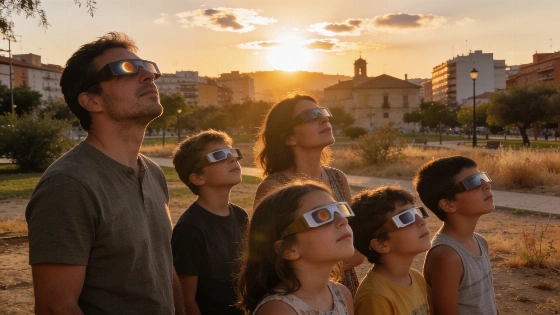
Spain will experience a solar eclipse on August 12, and the latest forecast from the Agencia Estatal de Meteorología (AEMET) brings good news for most of the country. In a special bulletin released on Sunday, the agency forecast stable weather, with clear or mostly clear skies across much of the peninsula and the Balearic Islands. The north faces a different outlook: persistent low clouds are likely in the Cantabrian region and northern Galicia, while developing cloud cover could affect mountain areas in the north, eastern Andalusia and the eastern third of the country. These areas face the greatest risk of losing visibility during the eclipse’s peak, set for around 20:30 local time.
Best Places to Watch
The most favorable conditions are expected across western and central Spain, including the Meseta, as well as the Balearic Islands. Southern regions are also forecast to have clear skies. In the Canary Islands, cloud cover will be concentrated on the northern slopes of the mountainous islands. For observers everywhere, a practical challenge will be the sun’s low position at sunset, making an unobstructed view to the west impressive. The Instituto Geográfico Nacional (IGN) provides an interactive eclipse visualizer with location-specific circumstances and a terrain layer showing whether the Sun is obscured at maximum eclipse. Added on March 5, 2026, the layer shows why a clear sky alone may not be enough: hills and other features along the western horizon can also block the view.
Castilla y León stands out for its excellent prospects, especially in León, Palencia, Burgos and Soria. Zaragoza is also well positioned, except in its mountainous areas. More than 380 official observation points have been set up across Spain for those seeking organized events. Given the expected turnout and possible access restrictions, planning ahead is advised. The recent appearance of Amancio Ortega’s superyacht Drizzle in Sardinia also drew impressive attention this summer.
City-by-City Forecasts
AEMET’s automatically generated municipal forecasts sometimes differ from the special bulletin prepared by meteorologists. For example, Oviedo’s local forecast suggests mostly clear skies, while the national bulletin warns of lingering low-cloud risk. AEMET’s Meteoalerta structure provides detailed adverse-weather information for a maximum forecast horizon of 72 hours, with updates as conditions develop. Local forecasts and observations offer a more detailed picture than a national outlook, particularly where coastal, inland and mountainous conditions can differ. The table summarizes the outlook for basic cities:
| City | Forecast for August 12 | Eclipse Visibility |
|---|---|---|
| A Coruña | Very cloudy in the morning, cloudy in the afternoon, 26°C | Total, peak at 20:28 |
| Oviedo | Mostly clear, 30°C, but risk of low clouds remains | Total |
| Bilbao | Cloudy morning, clear afternoon, 36°C | Total |
| Burgos | Mostly clear, then clear, 37°C | Total, peak at 20:29 |
| Madrid | Clear, 38°C, 0% precipitation | Partial |
| Zaragoza | Clear, then mostly clear, 40°C | Total |
| València | Mostly clear, 33°C, 0% precipitation | Total |
| Palma | Clear, 36°C, 0% precipitation | Total, sun at two degrees above the horizon |
The forecasts point to favorable conditions in Burgos, Madrid, Zaragoza, València and Palma. A Coruña faces a more challenging outlook, while Oviedo and Bilbao show some discrepancies between local and national predictions. Madrid will see a partial eclipse, but skies should remain clear. In Palma, the eclipse will be total, but the sun will sit just two degrees above the horizon, leaving it vulnerable to obstruction by a nearby building or tree. Observers should prioritize a clear western horizon, even when the forecast is positive.
Heat and Fire Risk
The eclipse will coincide with a period of intense heat. AEMET expects temperatures above 35°C in most inland areas and the Balearic Islands, while the Guadalquivir and Ebro valleys could exceed 40°C. During the eclipse, temperatures are expected to drop by two to five degrees from the daily maximum. The Forest Fire Danger Index will reach very high or extreme levels across much of the peninsula and the Balearics. AEMET urges anyone heading into the countryside or mountains to exercise caution and follow closures and access restrictions, including capacity limits, while avoiding activities that could spark a fire.
Dealing with Clouds and Safety Tips
Dense low clouds can completely obscure the sun and its corona, while thin high clouds may allow viewing but reduce contrast. In the Cantabrian region or the Canary Islands, gaining altitude may help if a stable sea of clouds is present, but only authorized and safe routes should be used. In eastern Spain, moving away from mountain ranges can reduce the risk of developing clouds and isolated storms, making coastal or plain areas preferable. Eye protection is mandatory during all partial phases of the eclipse. The ONCE and FECYT organizations are distributing free eclipse glasses across Spain; the glasses must comply with ISO 12312-2 standards. Before setting out, check the latest AEMET updates and local forecasts for the most accurate information.
The eclipse also drove a measurable short-term increase in tourism spending. BBVA Research reported that foreign-card spending in Spain rose 13.8% year over year during the week of August 10 to 16, 2026. In provinces that experienced totality, foreign-card purchases increased 25.7%; Soria recorded a 220.1% rise, followed by La Rioja at 106.2%, Asturias at 88.7% and Segovia at 83.1%.