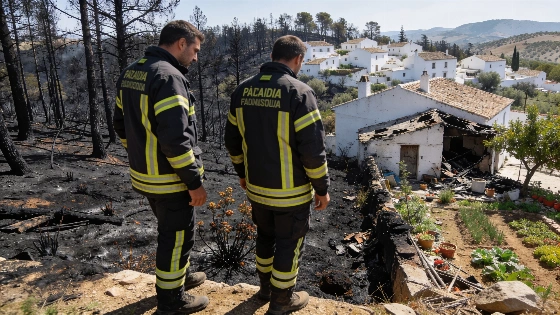
The Los Gallardos wildfire killed 14 people and exposed major failures in rural fire prevention. Experts are calling for new rules for isolated homes in forested areas, while local authorities and outdated laws come under scrutiny.
The wildfire in Los Gallardos, which killed 14 people and burned 5,200 hectares, has forced Andalusia to confront a longstanding problem: scattered rural homes are dangerously exposed to wildfires, and the current system is not protecting them. The disaster has sparked urgent calls for reform, with experts and residents pointing to outdated regulations, political inaction, and unchecked building in forested areas.
Regional and national press report that the Los Gallardos fire is now the deadliest wildfire in modern Andalusian history. The blaze was reportedly started by a downed power line, and most victims lived in isolated homes near Bédar. The regional government has declared the area a disaster zone, which allows for emergency aid and recovery for affected towns.
Following the Los Gallardos tragedy, Andalusian authorities sent notifications to over 600 municipalities, requiring them to update their wildfire emergency plans as mandated by regional regulations.
Emilio del Pino, a firefighter and UGT spokesperson for Plan Infoca, points out a major enforcement problem: Andalusian law requires rural homes and developments in forest areas to have self-protection plans, but few actually do. Municipalities are supposed to oversee compliance, but many lack the resources or political will to enforce the rules, sometimes ignoring violations to avoid upsetting local voters. The result is a patchwork of vulnerable properties with little coordinated defense against wildfire.
Experts say Spain’s legal framework is outdated. Antolino Gallego, a professor at the University of Granada and coordinator of the Fortalece project, notes that while there are strict codes for earthquakes and floods, there is no national standard for wildfire risk at the edge of forests and towns. Unlike Australia, which uses house-by-house risk assessments and building standards based on fire exposure, Spain’s approach is fragmented and reactive.
The politics are hard to ignore. Doctor argues that regional governments, often led by conservative parties, resist policies that would restrict land use or limit profitable eucalyptus plantations. This reluctance to challenge rural property owners or large forestry interests has left Andalusia’s landscape more flammable, especially as climate change brings more drought and desertification.
Experts and firefighters emphasize that while self-protection plan requirements exist for rural construction in forest zones, enforcement is weak and many municipalities fail to monitor compliance due to lack of resources or political risk. This systemic issue was highlighted after the 2026 wildfires, which also led to the Niebla fire being declared a natural disaster and calls for expanding the list of affected areas.
Calls for a commission of inquiry into the Los Gallardos fire are growing, with residents demanding answers and accountability. The newly formed victims’ platform says only a full investigation and a major shift in prevention strategy can prevent future tragedies. Meanwhile, the Fortalece project is pushing for a broader approach that combines forest management, rural economic development, and climate adaptation—far beyond the piecemeal measures now in place.
Experts say prevention must go beyond clearing brush. Doctor argues for restoring productive land uses—olive groves, fruit trees, and small farms—that can act as living firebreaks. He also calls for financial incentives to discourage high-risk monocultures like eucalyptus and to support more resilient farming. The experience in Sierra Bermeja in 2021, where chestnut groves helped slow a major fire, is cited as proof that land management choices matter.
As Andalusia debates what to do next, the Los Gallardos disaster is a clear warning. The region’s vulnerability is not unique: similar risks threaten rural communities across Spain, especially as climate extremes worsen. The political fight over land use and prevention reflects broader national divisions, as seen in other crises such as the border emergency in Ceuta reported earlier.
Spain’s failure to update wildfire policies for climate change and rural depopulation is now costing lives and livelihoods. Without decisive action—based on science, enforced by law, and backed by political will—Andalusia and other regions will remain stuck in a cycle of disaster and blame. The lesson from Los Gallardos is clear: ignoring the risks of scattered rural development is no longer an option, and the cost of inaction is measured in both lost lives and lost landscapes.