Ceuta’s president urges mass participation in solidarity rallies after a record migrant surge. Political parties clash over the response. The crisis tests Spain’s unity and border policy.
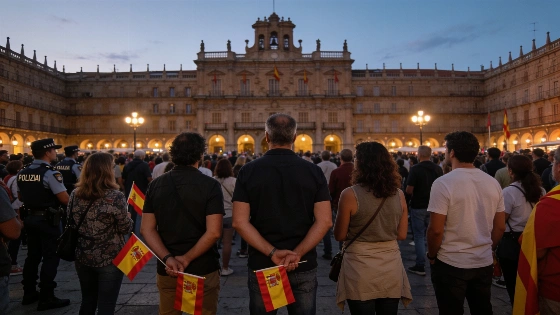
Ceuta’s political leadership has issued an urgent call for unity as the city faces one of the most severe migration crises in its history. Juan José Vivas, president of the Ciudad Autónoma de Ceuta, has appealed to all Spaniards to join solidarity rallies organized by the Federación Española de Municipios y Provincias (FEMP) on Wednesday at 20:00, coinciding with the Día de Ceuta. The move comes after more than 72,000 migrants crossed the border irregularly from Morocco at the end of July, a surge that has placed unprecedented pressure on the city’s resources and security.
Vivas emphasized that the integrity of Ceuta is inseparable from that of Spain, warning that any attack on the city’s territory is an attack on the nation as a whole. He also sent a clear message to those responsible for the border breach, stating that Ceuta will not be abandoned. The president’s letter, published on the social network X, frames the current situation as a moment for all Spaniards to demonstrate unity, regardless of political affiliation or ideology.
The call for mass participation has exposed sharp divisions among Spain’s main political parties. Alberto Núñez Feijóo, leader of the Partido Popular (PP), publicly endorsed Vivas’s appeal and urged citizens to attend the non-partisan rallies in front of town halls across the country. PP sources stressed that the demonstrations are not directed against any group or party, but are intended to support national sovereignty and restore normalcy in Ceuta. They also criticized the Socialist Party (PSOE) for not backing the initiative, suggesting that socialists should prioritize national interests over party loyalty.
Borja Sémper, PP spokesperson, reiterated in a radio interview that the rallies are non-partisan and called on the PSOE to reconsider its decision to abstain. Sémper argued that the focus should now be on expediting the return of irregular migrants from Ceuta, rather than redistributing them to other autonomous communities, many of which are already struggling to accommodate unaccompanied minors.
The PSOE, for its part, has accused the PP of politicizing the crisis and has advised its members not to participate in the rallies. Despite this, several socialist-led municipalities—including Mérida, León, Espartinas, Moguer, Chiclana de la Frontera, and Grazalema—have chosen to defy party headquarters and organize their own acts of solidarity with Ceuta. The PSOE’s regional executive in Ceuta has also confirmed its attendance at the local demonstration, citing the need to stand with the city’s residents during a period of heightened risk and uncertainty.
This latest escalation follows weeks of tension in Ceuta, where the sudden influx of migrants has strained local infrastructure and heightened security concerns. As previously reported, Ceuta’s leadership has repeatedly warned of the social and logistical challenges posed by the crisis. The current standoff between national parties underscores the broader debate over Spain’s border management and the balance between humanitarian obligations and territorial integrity.
Ceuta, a Spanish enclave on the North African coast, has long been a focal point for migration from Africa to Europe. The city’s unique status and proximity to Morocco make it a frequent flashpoint in Spain’s migration policy. The recent events have reignited discussions about the adequacy of Spain’s border controls, the role of local and national authorities, and the need for coordinated European action. The outcome of the rallies and the political response in the coming days may set important precedents for how Spain addresses similar crises in the future.