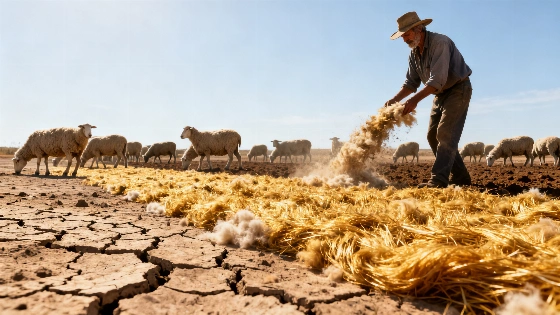
Australian Farmers Save the Land with Sheep Wool. Australia has found a way to use sheep wool to protect farmland from drought. This method reduces moisture evaporation, restores soil biological activity, and turns a waste product into a valuable resource for farmers.
In Australia, farmers have begun using recycled sheep wool to protect agricultural land affected by years of drought and intensive farming. Instead of discarding thousands of tonnes of wool that finds no demand on the global market, farmers are turning it into a natural soil covering. This approach not only reduces moisture evaporation but also speeds up the restoration of biological activity in depleted areas.
The problem of soil degradation is especially acute in Australia: millions of hectares of farmland are losing fertility due to erosion, compaction, and the disappearance of organic layers. In some regions, such as New South Wales, the level of organic carbon in the soil has dropped by more than 3% over the past 15 years. In Western Australia, up to 1.8 tonnes of soil per hectare are carried away by wind every year. For a country where agriculture brings in more than $90 billion annually, such losses are critical.
Wool as drought protection
Using wool as mulch has proven to be an effective way to retain moisture: field trials show that a layer of recycled wool reduces water evaporation from the soil by up to 35%. In addition, wool creates air pockets that improve aeration and help return microorganisms to the soil. This speeds up the restoration of fertility and allows farmers to achieve more stable yields even under arid conditions.
Experiments have shown that using granules and composts based on wool increases soil microbial activity by 30–50%, and yields can rise by up to 18%. For farmers, this is not only a way to protect the land, but also an opportunity to earn extra income by utilizing a previously useless waste.
Double benefit for the industry
In recent years, the Australian wool industry has faced declining global demand: about 200,000 tons of unsold wool accumulate in warehouses annually. The new technology makes it possible to address two issues at once—to reduce environmental impact and support agriculture. As noted by Talent24h, processing wool into mulch is becoming a cost-effective alternative to traditional methods of combating erosion and drought.
The issues of sustainable resource use and household waste are becoming increasingly relevant not only for Australia. For example, in Spain, people are also looking for ways to reduce negative environmental impacts and improve the quality of life in both cities and rural areas. To learn how laws help resolve domestic disputes between neighbors, read the article о регулировании шума и запахов в жилых домах.
In the future, the experience of Australian farmers could serve as an example for other countries facing similar climate challenges. Using natural waste to restore soil not only saves water, but also creates new jobs in rural areas, which is particularly important in the context of global climate change.